The most productive people have surprisingly simple routines. They don’t wake up wondering what they’ll do first. They simply follow a routine that works.
It’s predictable, it’s consistent, and yes, it’s a little boring. But that’s the secret.
Productivity is about doing ordinary things consistently enough that they produce extraordinary results over time.
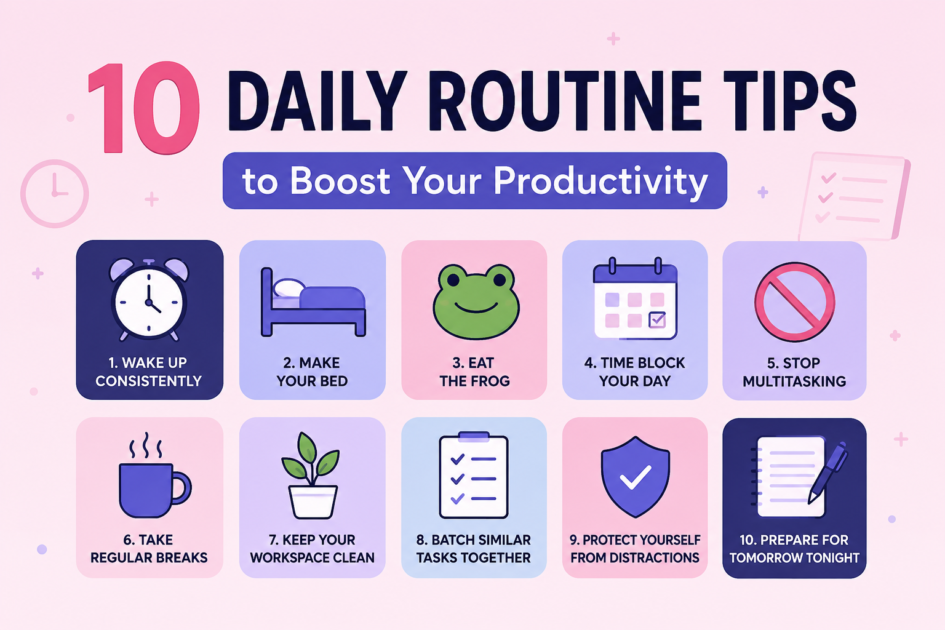
Here are a few practical daily routine tips to help you get more done. Feel free to pick the ones that fit your lifestyle and skip the ones that don’t.
1. Wake Up at a Consistent Time
Despite what social media would have you believe, you don’t have to wake up at 5 a.m. to be productive.
If you’re naturally more productive at 7 a.m., great. If 9 a.m. works better because of your schedule, that’s perfectly fine too. What matters is the consistency.
Your body loves routine. A consistent morning routine each day helps regulate your internal clock.
Plus, a consistent wake-up time reduces small daily decisions. You know when your day starts, so everything becomes easier to plan.
The goal isn’t to impress people with how early you wake up, but to be rested enough to tackle the day.
2. Make Your Bed (Seriously)
Making your bed won’t shorten your to-do list or make your work disappear, but it makes everything less chaotic.
A tidy room is one less distraction, especially for those working from home. It’s easier to focus when your surroundings don’t constantly remind you of unfinished chores.
Visual clutter competes for your attention even if you don’t consciously notice it.
It only takes a couple of minutes to make your bed. Pull up the blankets, arrange the pillows and straighten the sheets. It doesn’t have to be perfectly done.
Making your bed may not be the secret to becoming wildly productive, but it’s a reminder that productivity is often about doing the small things consistently.
3. Eat the Frog
The ‘frog’ is your biggest, most important, and often most challenging task of the day.
It’s not necessarily the one that takes the longest, but it’s the one that will make the biggest difference if completed.
Eating the frog means tackling this task first thing in the morning. This does two things:
One, your mind is still fresh and you have more focus and mental energy. Why waste your best hours on less important tasks with little impact?
Two, it unburdens your mental weight. You don’t spend the rest of the day thinking, ‘I still have to do that one thing.’
Finish it early and the rest of the day feels noticeably lighter.
4. Time Block Your Day
It’s easy to spend the day reacting instead of working. Every task feels urgent and every notification prompts you to give it a quick look.
Before you know it, the day is almost over and you have to squeeze important work into whatever time is left.
Time blocking gives every part of your day a job. That doesn’t mean your schedule has to be planned down to the minute. You also schedule breaks and unexpected tasks.
Planning becomes easier once you see where your time is really going.
5. Stop Multitasking

Multitasking has a great reputation, but a terrible track record. It feels productive since you’re doing several things at once.
The problem is that none of those tasks get your full attention. You read the same paragraph three times because you keep checking your phone and you send an email only to spot an embarrassing mistake seconds after hitting Send because your attention was somewhere else.
Our brains struggle to perform multiple thinking tasks simultaneously. They switch between them. And with every switch, you lose your train of thought, spend a few moments figuring out where you left off, and then repeat the cycle the next time something grabs your attention.
A better approach would be to work on a single task, finish it or reach a natural stopping point before moving on to the next.
Giving one task your full attention gets it done better and faster than splitting your focus across five different things.
6. Take Regular Breaks
Sitting at a desk for six straight hours has somehow become a badge of honor.
Working longer doesn’t mean working better. Everyone reaches a point where they’re technically working, but not really. When you open a spreadsheet, close it, and then open it again, that’s usually a sign that you need a break.
Step away for five or ten minutes, stretch your legs, make a cup of coffee or tea. Move your body while you’re at it. A short walk around the office or climbing a flight of stairs is enough to break up hours of sitting.
By the time you sit back down, your mind is fresher than it was ten minutes earlier.
7. Keep Your Workspace Clean
It’s difficult to concentrate when there’s a coffee mug from yesterday on your desk and three notebooks are open, none of which you need. The sticky notes are missing and the pen you were holding a minute ago has disappeared.
A messy workspace creates dozens of tiny interruptions. Time that would’ve gone straight to work is spent looking for chargers and moving papers around.
Keeping your workspace clean prevents all this. Put away what you don’t need and the things you use every day within reach.
Throw out old notes and anything that’s been sitting on your desk for weeks without a purpose.
A clean and tidy workspace makes it easier to focus.
8. Batch Similar Tasks Together
Doing similar tasks together is more efficient. Jumping from writing a report to making a phone call, then attending a meeting and then going back to the report is hectic. You can’t even remember where you left off.
Task batching keeps task hopping to a minimum. Handling similar tasks together is far more efficient than constantly leaving them halfway and returning to them later.
9. Protect Yourself From Distractions
Distractions arrive disguised as something harmless – a news headline or a message from a friend.
That ‘two-minute’ scroll easily turns into twenty and one video becomes three.
The easiest way to avoid distractions is to make them difficult to reach. Close tabs you’re not using and leave your phone in another room when doing deep work.
Just as importantly, learn to say no. Not every favor needs an immediate yes and not every request deserves to jump to the top of your priority list.
Protect your priorities before someone else’s priorities become yours.
10. Prepare for Tomorrow Tonight
A trick that has worked for me over the years is spending the last five or ten minutes of my work day doing a quick review of the day.
Take a look at your day. What have you completed and what is pending? Move all unfinished tasks to tomorrow and make them your priority.
Make note of tasks that took longer than expected. And if you completed more tasks than you planned, give yourself credit for it.
This is also the time to set up for tomorrow. Write down your top priorities and check your calendar so there are no surprises. Tidy your desk if you work from home.
Go to bed early so you can wake up fresh for the next day.
It’s All About Consistency
If there’s one thing to take away from all of this, it’s that productivity is built on what you do over and over again.
A productive daily routine looks remarkably similar on most days, and that’s what makes it effective.
The goal is to make good habits so ordinary that you no longer have to think about them.