Getting started is often the hardest part of any task.
Our brains love to inflate work into something bigger and more complicated than it actually is. So, we delay and stall, and promise ourselves we’ll start later.
The two-minute rule helps with this. It’s a surprisingly simple productivity technique that helps you overcome the inertia that fuels procrastination.
Here’s all you need to know about the rule and how you can start using it to beat procrastination and get more done.
What Is the Two-Minute Rule?
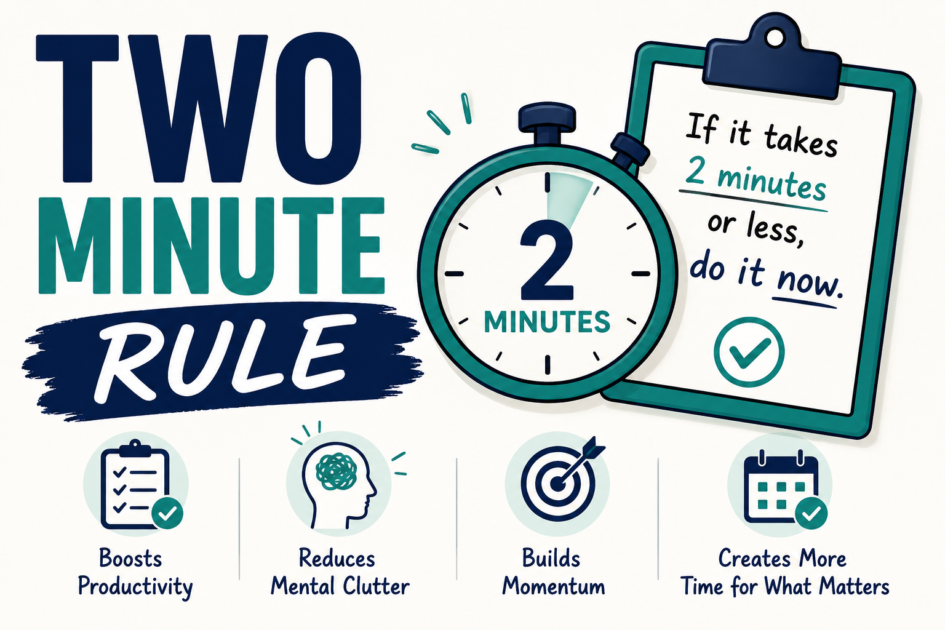
The Two-Minute Rule is a simple productivity principle:
If a task takes two minutes or less to complete, do it immediately.
Instead of telling yourself you’ll get to it later, you handle it right away and move on.
Productivity expert David Allen introduced the idea in his book Getting Things Done. His philosophy is that small tasks shouldn’t clutter your to-do list. If they are quick to complete, the most efficient approach is simply to do them.
Numerous small tasks probably pop up throughout your day. A quick email that needs a reply, a file that needs to be saved in the right folder, or a coworker asking for a simple confirmation.
None of these tasks are difficult. But they create unnecessary mental clutter if you let them pile up.
When the Two-Minute Rule Works Best
The two-minute rule works best when small tasks start piling up and draining your attention. They are easy individually, but they can easily accumulate into a surprisingly heavy mental load.
It’s particularly effective when you’re clearing small bits of work that don’t require deep focus.
The brief moments after finishing a task are perfect for knocking out quick actions that would otherwise clutter your day.
Examples of tasks that fit the two-minute rule include:
- Putting away items on your desk
- Writing down an idea before you forget it
- Sending a quick update to a colleague
- Replying to short messages and emails
- Filing or saving a document
- Scheduling a quick call or appointment
Why the Two-Minute Rule Works
The strength of the two-minute rule lies in its simplicity. Here are a few reasons behind its success.
1. It Eliminates Decision Fatigue
Decision fatigue is one of the biggest hidden drains on productivity. Your brain constantly evaluates tasks – whether to tackle them right away, when to do them, and how long they’ll take.
Even simple tasks can trigger this mental negotiation.
The two-minute rule removes this mental back-and-forth. You make the decision to tackle the task right away.
That frees up your mind for more important things.
2. It Prevents To-Do List Overload
Your to-do list can easily become overwhelming when you fill it with small, trivial tasks. Things like saving a file and sending a quick email end up sitting on the same list as bigger and more important work.
The two-minute rule prevents this from happening.
Immediately completing tasks that take two minutes or less means they’ll never make it to your list in the first place. Therefore, your to-do list remains with important tasks that require time and attention.
3. It Builds Momentum
Like pushing a heavy object, the first push takes the most effort. But once it starts moving, it becomes easier to keep going.
Small tasks behave in a similar way. Each task you take on gives you a small psychological win. You see progress, and it makes you feel productive. It gives you the encouragement to tackle the next task.
Those small wins quickly add up. What started as a simple two-minute action plan can compound into several completed tasks in a row.
Do’s and Don’ts of the Two-Minute Rule
The two-minute rule works best when applied thoughtfully. But a few mistakes can prevent it from being successful.
Here are a few do’s and don’ts to keep in mind.
Do’s
1. Use it for genuinely quick tasks, those that take two minutes or less. These are often faster to complete than to track for later.
2. Handle a small task right away if it keeps popping into your mind. The goal is to eliminate the tiny responsibilities that keep lingering in the back of your thoughts.
3. Use the rule as a way to start bigger tasks. Committing to the smaller tasks can break the initial resistance and help you get moving.
Don’t’s
1. Don’t let the rule interrupt your deep work. Constantly switching to handle two-minute tasks can break your concentration and momentum. On such occasions, you’re better off noting the task and handling it later, once you’re done.
2. Some tasks look like they’ll only take two minutes but expand to ten or fifteen. If a task requires thinking and planning, it’s better to schedule it properly.
3. More importantly, don’t use the two-minute rule to avoid important work. The rule is designed to support your productivity, not distract you from high-priority work.
Do It Right Away
The two-minute rule sounds too simple to matter. But it’s in this simplicity that productivity increases.
It tackles small, trivial tasks and frees your time for projects that really matter.
So, the next time a small task pops up and you catch yourself thinking, “I’ll do it later,” pause for a second.
If it takes less than two minutes, do it right away.