The simpler a system is, the easier it is to maintain. This is true for budgets, for fitness, and more importantly, for productivity.
We often abandon planning not because we’re lazy, but because the system becomes heavier than the work itself.
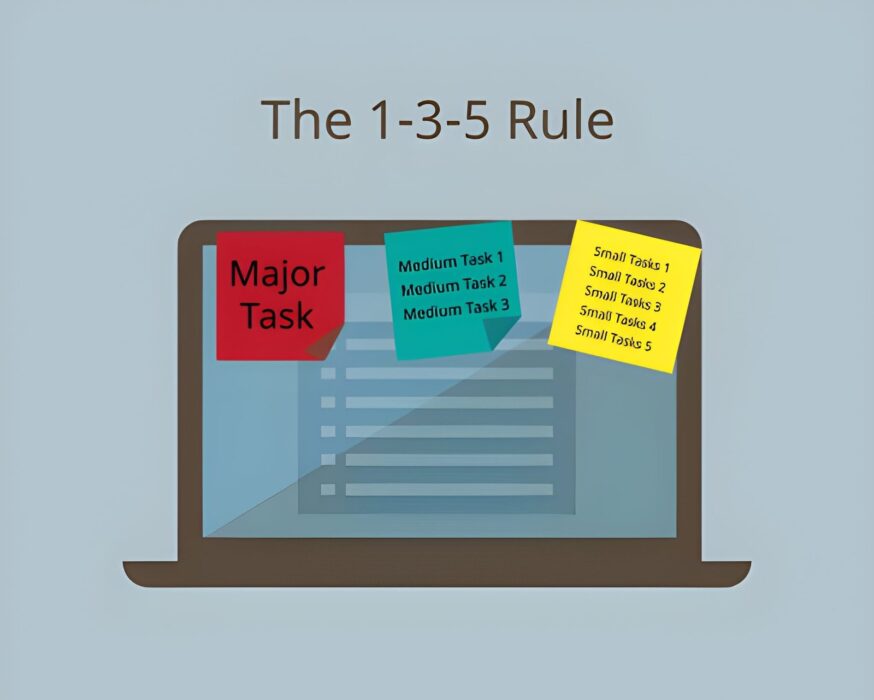
The 1–3–5 rule of productivity is intentionally simple. It lets you commit to just nine intentional tasks:
- 1 big task
- 3 medium tasks, and
- 5 small tasks
That’s it!
Here’s a more elaborate explanation.
What is the 1–3–5 Rule?
The 1–3–5 rule is a productivity technique that promotes realistic planning and focused execution. It makes you structure your day around 9 tasks, categorized by size and effort.
With the method, you commit to completing:
- 1 large task
- 3 medium tasks
- 5 small tasks
The goal is to constrain yourself to only these tasks. It encourages prioritization and aligns workload with typical human capacity.
So, what are these tasks?
1 Large Task
The large task is the main event, your frog.
It is the one task that, if you complete, the rest of the day feels productive even if you get nothing else done.
It is also the task that will likely consume a bigger portion of your work time and mental energy.
Your large task will likely involve:
- Strategic thinking
- Deep work
- Intense focus
- A meaningful deliverable
But, you only get one large task. Not two or three major tasks. But one.
That forces prioritization. You have to choose what truly matters today. And once you find it, you protect it, time-block it, and guard it.
You treat it like the priority it is.
Examples of large tasks include:
- Developing a product feature.
- Writing a full blog post.
- Recording a long-form video.
- Preparing a client proposal.
3 Medium Tasks
Medium tasks are still meaningful, but less demanding than the primary task.
They require focus, but won’t consume your entire cognitive bandwidth. Typically, they will take 30 to 90 minutes.
The tasks are characterized by:
- Moderate impact on goals
- Manageable time requirement (30 to 90 minutes)
- Focused attention, but not full deep work immersion
These tasks will allow steady progress but won’t overwhelm the schedule.
Examples of medium tasks include:
- Creating outlines
- Editing a draft
- Hosting a team meeting
- Making a client call
The medium tasks are three to prevent stacking. You add more and you risk overloading your day. Three keeps you honest.
5 Small Tasks
Small tasks are short duration and low complexity activities. They are important but don’t require deep concentration.
They mostly include:
- Admin work
- Responding and sending follow-up emails
- Scheduling meetings
- Sending and paying invoices
Such tasks maintain flow and prevent things from piling up. Since they are small,they typically take only a few minutes each.
Who Is It For?
The 1–3–5 rule is for those who need a structure, but not something rigid or complicated. It is structured to prevent chaos and light enough for daily use.
You’ll find it most useful if you are:
- A professional with competing priorities.
- Creatives e.g., writers, designers, developers, and consultants.
- If you overload yourself with a long to-do list.
- Anyone who struggles with end-of-day guilt because they are always behind.
But as efficient as it is, the 1–3–5 rule doesn’t apply everywhere. It will likely fall apart when you use it for:
- Crisis or emergency days.
- Highly reactive roles like operations roles and on-call positions.
- Early stages of a startup where priorities will change daily and everything feels urgent.
Why the 1–3–5 Rule Works
The 1–3–5 rule strips away all the complexities of a productivity system. Its strength lies in its simplicity.
Here are a few reasons why it sticks.
1. Forces Prioritization
You are limited to nine tasks only. So, you have no choice but to make cuts upfront. Plus, you can’t label everything as important.
This forces prioritization. You must identify what is important before the day begins. This way, you avoid the constant, exhausting ‘What do I do next?’ mental load.
2. Balances Ambition With Realism
It’s easy to overestimate what you can accomplish in a day. Long lists will make you feel like a failure by evening.
The 1–3–5 rule respects reality and matches what you can reasonably complete. It builds long-term productivity habits that increase consistency and reduce stress.
3. Creates Momentum
It certainly feels good to knock out a few medium and small tasks in a day. It gives you a sense of visible progress which fuels motivation and reduces procrastination.
These small wins build momentum naturally without forcing superhuman effort.
4. Encourages Reflection
Given that the structure is clear, it’s easy to review your progress at the end of the day.
- Did you complete your big task?
- Did the medium and small tasks support progress?
Anything left can roll over to the next day. You learn how much you can handle, which improves planning over time.
How to Implement the 1–3–5 Rule Step-by-Step
To use the 1–3–5 rule, you need a simple, repeatable process that fits into your day. Here’s a practical, step-by-step approach to make it work.
Step 1: Brain Dump Everything
The Getting Things Done technique tells us that our brain is poor at storing information. As such, start by dumping everything in your mind onto paper or a digital tool.
List down all tasks, ideas and obligations that you must complete. Don’t judge or filter, just get it all out.
The goal is to capture everything and look at it as a complete picture. All this is your raw material.
Step 2: Rank by Importance, Not Urgency
Don’t start scheduling yet. Once you’ve listed everything, the next step is to rank them based on impact, not deadline.
Ask yourself which tasks would make a difference if completed today? Which ones will make you feel productive even if you do nothing else?
This is the moment you separate signal from noise.
Step 3: Assign 1–3–5 Slots
The third step is to structure them. You need one large task, three medium ones and five small tasks.
The large task defines your day. The medium ones are important but won’t drain all your energy, while small tasks are routine admin tasks that keep the momentum going.
If you find something that doesn’t fit in the three categories, it probably doesn’t belong in today’s list. You can move it to tomorrow or backlog it.
Step 4: Time-Block the Big Task
Your large task is the most important. It deserves protection. Schedule it when your energy is highest, usually in the morning, or your personal peak time.
It is a non-negotiable task, so treat it like one. Silence notifications and minimize distractions.
Remember, finishing this task alone makes the day a success.
Step 5: Review at the End of the Day
Before you close out the day, take a few moments to reflect:
Did you finish the big task? What about the medium and small ones? Is there anything you struggled with?
Don’t beat yourself up if you didn’t complete everything. You’re still learning. Use the cues to adjust your future lists based on what you can realistically achieve.
With time, you’ll get better with understanding your energy patterns and estimating your effort.
Mistakes to Avoid With the 1–3–5 Rule
It’s easy to implement the 1–3–5 rule, but it’s also easy to screw it up. The structure works only if you respect it. Here are the common ways people sabotage it.
1. Having More Than One Big Task
A common way users break the technique is by having more than one big task.
You are overloading if you stack multiple heavy, demanding tasks.
One major win a day is enough to force clarity and protect your energy.
If you have two equally important tasks, choose one and then preserve the other for the next day.
2. Mislabeling Tasks
A task that takes three hours isn’t small, however much you want it to be. It’s also not small if it drains your mental energy. Mislabeling tasks defeats the principle the rule is built on.
3. Allowing Small Tasks to Expand
It’s easy for small tasks to multiply. You begin with five, but then an email comes in, and another invoice. And suddenly your day turns into admin maintenance.
Small tasks should support your day, but not dominate it. Protect the big task first, and then the medium and small tasks will fill the gaps.
4. Being Too Rigid
Rules are frameworks, and they’re not set in stone. Some days will break the system.
Emergencies will happen, meetings will run longer than anticipated and energy will dip. If you manage to complete the big task and two medium tasks, that is still a strong day.
Productivity isn’t perfect.
Don’t Quit
Like all systems, getting used to the 1–3–5 rule takes time. You may not get it the first few tries, but that’s not a reason to give up.
Review your performance every day and adjust. You’ll get better over time.
Remember, even completing one big and one medium task still counts as a win!