At Legit Productivity, we don’t buy into the idea that being productive means chaining yourself to a desk for twelve hours a day.
Isn’t that what the Eisenhower Matrix teaches us? That you can be busy all day and still not move the needle.
True productivity is about getting the right things done, so you can have more time to breathe and live.
If this sounds like something you’ve been needing, a way to stop being busy and start being truly productive, consider these strategies we use to get more done every day.
They seem to be working for now.
1. Wake Up Early
I know, this probably isn’t the news you want to hear. Nobody loves the sound of an alarm clock dragging them out of bed earlier than they want to.
But if you want to get anything meaningful done, those early hours are magic. They are calm and quiet, and there are fewer distractions. You give yourself a head start before the rest of the world wakes up.
Now, this isn’t to mean you have to force yourself into the 5 AM club if it doesn’t suit you. Some of us are early birds while others thrive naturally as night owls. Find your rhythm and stick to it.
2. Plan Ahead
You kill your productivity when you wake up without a plan. That’s because you’ll likely spend most of your morning deciding what to do, and by the time you are getting started, most of the day has already slipped away.
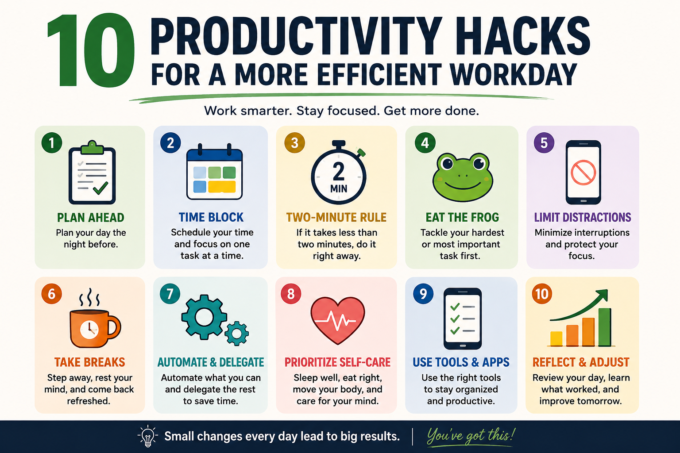
Fix this by planning ahead. It doesn’t have to be elaborate. You could jot down your top three priorities in a notebook or leave yourself a sticky note with the day’s tasks.
The goal is to remove that decision-making in the morning, so you can start with action and not hesitation.
I’ve found that planning my day the previous evening makes my mornings smoother and gives me more momentum.
3. Write it Down

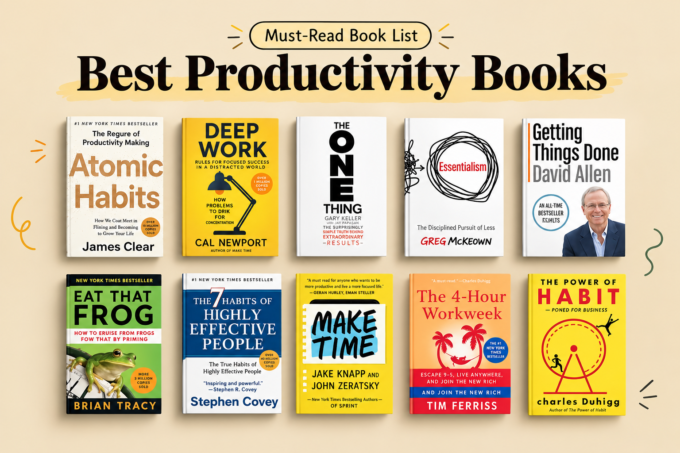
According to the Getting Things Done technique, your brain is a terrible storage unit. It’s for having ideas, not storing them. The more you try to remember your tasks and appointments, the more mental energy you waste.
Instead, capture everything. Get your thoughts from your head down onto paper.
When you journal it down, you don’t have to carry it around in your head, which frees up energy for the things that actually matter.
4. Eat the Frog
The Eat That Frog technique is where you start your day with the toughest, most uncomfortable but also most important task on your list.
When you leave the big task for later, you never give it the attention it deserves. By then, your energy will have dipped and distractions will begin to creep in. Before you know it, you are promising yourself to handle it ‘tomorrow.’
Make the conscious decision to eat the frog first, as ugly as it may be. By the time you are done, the relief and accomplishment make every other task seem lighter.
5. Productivity Techniques
Like many things in life, there is no one-size-fits-all approach to getting things done. What works wonders for me may leave you boxed in.
That’s why it’s important to experiment with different productivity techniques until you find the one that fits your rhythm.
Perhaps, the Pomodoro technique suits you best. You work in sprints of 25 minutes followed by a 5-minute break. Or maybe, you prefer to time-block. You dedicate chunks of your calendar to specific tasks and make sure all the important stuff has a place in your day.
Personally, I prefer a mix of different styles. I map out my day using the Eisenhower Matrix, then eat my frog before the day unfolds.
These techniques are tools to guide and shape how you work. Use them to your advantage.
6. Don’t Multi-task

However enticing, resist the urge to multi-task. You may think you are good at multitasking, but in reality, every switch is costing you focus and energy.
Nothing gets your best effort and you end up with more mistakes and loads of half-finished work.
You are more likely to be productive when you do one thing well and complete it before moving on to the next.
It may be less glamorous than juggling a dozen things at once, but the results speak for themselves.
7. Set Boundaries
Distractions are everywhere, from your phone to your coworker popping in for a ‘quick chat.’ And when you are working from home, you occasionally get tempted to do house chores instead of your real work.
Set boundaries to protect your attention. This may mean finding a workspace where you won’t be pulled in a million directions. Or silencing your phone, or better yet, keeping your phone in another room altogether.
Technology can also work in your favor. Focus apps like Forest will block distractions and create pockets of deep concentration.
8. Automate
One of the smartest moves you can make in work is to automate. Automate repetitive and low-value tasks so you have more time for work that matters.
There are different automation tools depending on your setup. Zapier will schedule emails for you and QuickBooks will set up auto-billing for clients.
The right system frees hours of your time. It’s like having a silent assistant who is never in your way and is more than happy to do the boring stuff.
9. Review and Reflect
You may not get it right the first time, and that’s perfectly fine. No one does.
Take a little time each week, maybe on the weekend, to review and reflect on the previous week’s work. Try to identify what worked and what didn’t.
Maybe your mornings slipped and you dragged on longer than you intended. Or maybe the technique you tried didn’t help you get more done.
When you identify the problem, you can fine-tune your habits and stop forcing yourself to stick with something that’s not effective.
10. Be Flexible
Life happens, and even the best-laid plans will occasionally get disrupted. A client will reschedule or your child will get sick. Something might happen abruptly that requires your immediate attention.
That’s why workplace flexibility is as important as discipline when it comes to productivity. If you plan everything down to the minute, one wrong thing can throw everything else off.
Leave buffer time in your schedule. This way, if anything goes wrong, you can always reshuffle.
And just because you didn’t tick off everything on your to-do list doesn’t mean you failed, it means you adapted.
The goal is to consistently move forward even when the day doesn’t go as planned.
Four Hours Are Enough
Productivity isn’t a talent reserved for the lucky few. It’s a skill you sharpen every day with the right habits and mindset.
You don’t need to sit at your desk the entire day. Research shows that four hours of deep work are enough to call it a productive day.
Plan ahead, cut distractions and find the right technique to get the most done. You won’t nail it perfectly every day and that’s fine.
What matters is that you show up and keep moving forward.