We often confuse productivity with constant motion. We believe that being occupied means being effective. That if you’re always doing something, you must be getting somewhere.
But does that really hold up?
Productivity is one of those words everyone uses, but almost no one slows down to define. It’s not about how busy you are or how long you work, but rather whether your effort becomes something that matters.
In this post, we strip it down to its basics. We give a practical understanding of what productivity means and how you can start applying it to your everyday life.
Defining Productivity
Productivity is about what you produce with what you have.
The ‘what you have’ part is your resources: time, energy, and attention. It’s how well you turn these limited resources into meaningful results.
In simpler terms,
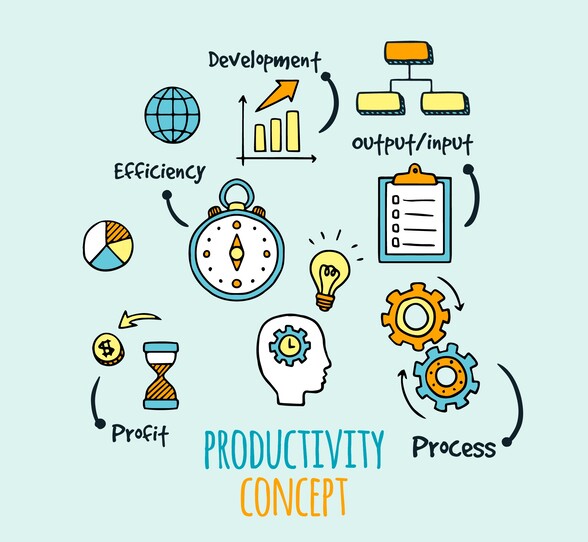
Productivity reflects the relationship between:
- What you put in (time, energy, attention)
- And what you get out (value, results, and completed work)
Productivity, therefore, isn’t how many hours you work or how busy your day feels.
If you spend nine hours working but accomplish very little, that’s not productive. But if you spend four focused hours and complete something important, that is.
Busy vs Productive
Being busy and being productive are often used interchangeably, but they are not the same thing.
Being busy means your time is filled. You are constantly doing something, like attending meetings and switching between tasks. There’s usually no idle moment. But when the day ends, you realize that the one thing you need to do is still sitting there, untouched.
Productive, on the other hand, means you direct your effort toward tasks that move you forward. You are not just doing things, you’re doing the right things.
Busy is noise, productivity is progress.
You can be busy all day and still feel like you did nothing of importance.
But there’s also an important distinction to remember. Productivity sits at the intersection of two things:
- Effectiveness – Doing the right things in the first place.
- Efficiency – Doing things well, with minimal waste.
You can be efficient but at the wrong tasks, and that still isn’t being productive. Productivity happens when you combine both–doing the right things, and doing them well.
Types of Productivity
Productivity can be broken down into different types, based on what resources you use. Here are the main ones.
1. Labor Productivity
Labor productivity is how efficiently people are working. It measures how much output is produced per worker or per hour worked.
2. Material Productivity
Material productivity measures how efficiently raw materials are used during production.
The focus shifts from people to resources. Are you wasting resources or are you squeezing the most out of them?
The goal is to minimize waste and maximize output from available resources.
3. Capital Productivity
This is about tools, machines, and money. Are the things you invested in helping you produce more? Capital productivity measures how well equipment is used to generate output.
4. Total Factor Productivity
Total factor productivity is everything put together. You take all inputs combined–labor, materials and capital, and look at how they can all work as a system.
It evaluates overall efficiency and performance instead of focusing on one resource.
How to Measure Productivity
Once you understand the different types of productivity, the next logical question is: how do you measure it?
At its core, productivity is measured using the formula:
Productivity = Output ÷ Input
Where:
Input – what you invest like time, energy, and resources
Output – what you produce e.g., tasks completed and results achieved
In real life though, it’s not always that straightforward. Here are practical ways to measure productivity:
1. Output and Time Spent
While starting tasks feels good, finishing them is what counts. Consider what you accomplish within a given time. Aim for meaningful output within your available time.
Three hours of deep, uninterrupted work will likely produce more meaningful results than an entire day of scattered effort.
A good way to measure productivity is to focus on value created per unit of time rather than time spent.
2. Progress Toward Goals
Not all productivity is immediate, and some tasks don’t come with a neat ‘done’ label. Things like planning and building take time.
So, instead of chasing completion, look for movement. Is the task in a better state than it was yesterday, and are you getting closer to finishing it?
Progress may be quieter than completion, but it is just as important.
3. Quality of Work
Running through tasks just to tick them off doesn’t count. If you have to redo it later, then you didn’t really save time. Instead, you delayed the work.
Productivity includes doing things well enough that they stick.
4. Energy and Sustainability
You won’t perform at the same level all day. There are moments when your focus will be sharp, and you can do your best work. And then there will be low-energy moments when everything feels slower and harder.
Ways to Improve Productivity

Improving productivity doesn’t require a complete life overhaul. Most of the time, it’s about making a few smart choices consistently.
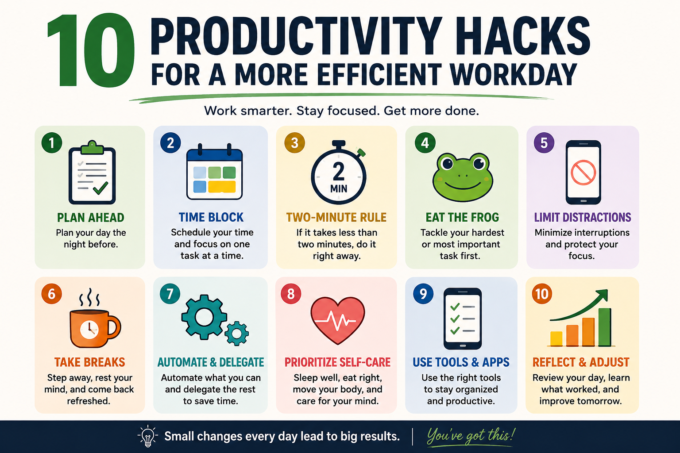
1. Prioritize
Not all tasks deserve your time and attention equally. Prioritize those that move your goals forward.
Focus on what will make the biggest difference if completed. Shift from doing more to doing what matters, and watch how quickly you improve your productivity.
2. Plan Your Day
Decide how you want your day to look, or your day will decide for you. And your day will choose busyness over productivity.
Spend a few minutes at the start (or end) of your day to plan what you’ll work on and how much time each task will take.
Doing this reduces decision fatigue and prevents your day from being full of random, unimportant tasks.
3. Time-Block
Time-blocking is when you assign specific periods of your day to specific tasks. You dedicate time for deep work and separate time for shallow tasks.
It’s a time management technique that helps you stay focused and ensure you don’t push aside important work.
4. Minimize Distractions
Distractions are among the biggest barriers to productivity. Even small interruptions can break your focus and set you back hours.
When you sit to work, silence unnecessary notifications and close irrelevant tabs. Create a work environment that supports focus.
Protecting your attention is important for consistent productivity.
5. Build Systems and Habits
Motivation is unreliable. That’s why you need to create a system that makes productivity easier to sustain.
But even your system doesn’t need to be perfect. You only need to do a few things consistently:
- Plan your day
- Start work at a set time
- Review what you did
Productivity is built on small actions repeated often enough that they become automatic.
Doing What Matters
Mastering productivity takes time, and you likely won’t fix it overnight. What matters is catching unproductive patterns early, and slowly building habits that last.
Even if you get one solid task done a day, that’s progress, and enough to move your work forward.