
Your to-do list keeps growing, but the hours in your day don’t.
You are jumping between errands and phone calls, yet somehow the most important tasks keep slipping through the cracks. Everything feels urgent, but the important stuff is still waiting.
The Eisenhower Matrix was designed to solve this kind of problem. It’s a straightforward way to spot what deserves your time and cut through the busyness for actual progress.
What is the Eisenhower Matrix?
The Eisenhower Matrix is a time management technique that was popularized by Dwight D. Eisenhower, U.S. President and five-star general. He had massive responsibilities on his plate, but was known to arrange them effectively.
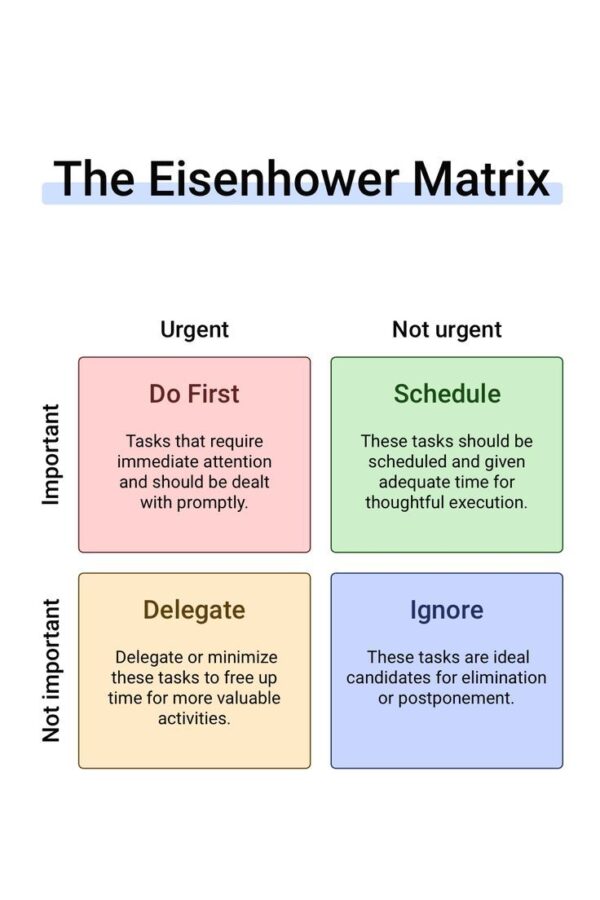
He organized tasks based on two questions: Is it important? and is it urgent?
Using this framework, you can classify tasks as important, urgent, both, or neither.
Breaking Down the Four Quadrants
The four quadrants are like a map for your time. They each tell you what to do with the task staring back.
Quadrant 1: Urgent + Important → Do It Now
The first quadrant is also known as the fire-fighting zone. It’s where the heat is on.
This box is for tasks that are both important and urgent. They are usually emergencies and pressing deadlines that require your immediate attention. You must prioritize them.
Think of tasks like:
- Completing a report that is due today
- Prepping for a presentation that is hours away
- A client is calling
- Your car breaking down on your way to work
When a client calls or your car breaks down, you don’t have the luxury of planning or postponing it. You can’t (and shouldn’t) ignore it.
What do you do instead? You drop everything and act.
Managing Quadrant 1
Quadrant 1 is unavoidable. Some tasks will land here because life is unpredictable and emergencies occur. That’s okay.
You need to handle these tasks to avoid serious consequences.
But be careful not to dwell here too much. Packing your days with urgent and important tasks often means you are ignoring Quadrant 2.
With time, small problems grow into crises, and everything starts to feel like an emergency again.
Quadrant 2: Important + Not Urgent → Decide
Quadrant 2 is the growth zone. These are tasks that don’t require immediate attention but are important in shaping your future.
Because they are not urgent, they are quiet, and you keep pushing them off for later. But that ‘later’ often turns to “never.”
This is why many people stay stuck in reactive mode, putting out fires instead of building the life they really want.
Excellent examples of tasks in Quadrant 2 include:
- Setting long-term goals.
- Planning for your career path.
- Exercising and taking care of your health.
- Budgeting and managing your finances.
- Working on personal projects.
When you zoom out and look at the bigger picture, these are the tasks that matter the most.
Managing Quadrant 2
You know you should spend more time here. But Quadrant 1 tasks prevent them from ever happening.
In his book, The 7 Habits of Highly Effective People, Stephen Covey writes that Quadrant 2 is where highly effective people spend most of their time. It is where you shift from surviving to thriving.
So, how do you make Quadrant 2 a priority?
1. Start small. You don’t need the entire day. Even a few minutes can help you learn something new or take care of your health.
2. Plan and schedule these tasks in your calendar, like you would for a meeting.
3. Treat Quadrant 2 tasks as non-negotiables, however many distractions try to sneak in.
4. Constantly remind yourself why these tasks matter in the long term.
The more time you spend on Quadrant 2, the more likely you are to escape the hamster wheel of busyness and start building the life you want.
Quadrant 3: Urgent + Not Important → Delegate It
Quadrant 3 is a sneaky one. These tasks feel important on the surface because they are urgent, but looking at them closely, you realize they don’t contribute much to your goals and long-term success.
That’s why this box is known as the distraction zone. You are constantly interrupted by noise and ‘urgent requests’ that keep you busy without moving you forward.
They trick you into thinking you are being productive when, in reality, you are not.
Quadrant 3 tasks include:
- Favors that are important to others but not aligned with your goals.
- Phone calls that pull you out of focus.
- Meetings that don’t require your presence but still take up your time.
Managing Quadrant 3
Spending time in Quadrant 3 means less time for Quadrant 2. You end your day exhausted without achieving anything worthwhile. Yes, you were busy, but you didn’t do the work that really matters.
How do you manage Quadrant 3 tasks?
1. Delegate if possible. If it doesn’t require your input or unique skills, hand it to someone else who can handle it just as well, if not better.
But what if delegation isn’t an option? Many freelancers work alone, which means you are the only one available. In this case, your best strategy is to contain the damage. Batch the tasks together and set strict limits on how much time you’ll allocate to them.
2. Set boundaries and learn to say no. Just because something is urgent to someone else doesn’t mean it’s urgent to you.
3. Before taking on a task, ask yourself: Is this important or is it just loud?
Quadrant 4: Not Urgent + Not Important → Delete It
Quadrant 4 is the easiest to recognize, yet the hardest to admit. These tasks don’t matter and are not urgent. In other words, they are purely distractions.
They include:
- Scrolling endlessly through social media.
- Watching “just one more” episode until it’s suddenly 3 a.m.
- Getting sucked into online debates and arguments.
- Checking notifications every few minutes out of habit.
- Playing mobile games to pass time.
Managing Quadrant 4
It’s not that rest is bad. If anything, it’s essential. A little harmless fun here and there helps balance life.
But there’s a difference between downtime and time-wasting. Quadrant 4 activities don’t actually recharge your energy. They numb you and leave you more drained in the long run.
Here’s how to handle these activities:
1. Be honest with yourself and notice when you are drifting into boredom or procrastination.
2. Before doing something, ask yourself, ‘Does this help me relax or escape?’
3. Put boundaries around your entertainment. One episode instead of five, and fifteen minutes of social media instead of an hour.
Delete those activities that don’t serve you to create time for the ones that do.
Mistakes to Avoid with the Eisenhower Matrix
The Eisenhower Matrix is a simple technique. But simple doesn’t always mean easy. Misuse it and you’ll find yourself slipping back into old habits.
Here are some common mistakes to watch out for with this technique:
1. Using the Matrix Once
A mistake most of us make is to discover the Eisenhower Matrix, try it once, and never return to it.
In the same way one workout won’t make you fit, one Matrix session won’t fix your time management for good.
The real value comes after days (or even weeks) of sitting and reshuffling tasks into the four boxes. If you only use it when overwhelmed, chances are you’ll fall back into the same cycle.
2. Treating Everything as Urgent
If you’re not careful, you’ll end up labeling everything as urgent and then miss the point of the Matrix.
A lot of tasks will look urgent because they are loud and attention-demanding or because someone else is pushing for them. Before labeling a task, ask yourself, ‘What happens if I do this immediately?’
If the answer is ‘not much,’ then the task probably belongs in another quadrant.
3. Overcomplicating It
Done is better than perfect.
—Sheryl Sandberg
The goal of the Matrix is to simplify your life, not complicate it. No need to perfect the boxes with color codes or endless subcategories.
Keep it simple, jot down the tasks, and place them where they mostly belong.
Spend less time fussing with the framework and more time working on the tasks.
4. Refusing to Let Go of Quadrant 4
The harsh truth is that unless you’re willing to let go of Quadrant 4 (social media and binge-watching), the Matrix won’t save you.
It’s easy to convince yourself that these activities are harmless and hang onto them. But they quietly eat up the hours you could have spent on productive work.
This isn’t to say you can never relax. Rest and leisure have their place, but not when they become mindless distractions.
Choosing What Matters
At the heart of the Eisenhower Matrix is a simple truth: not everything deserves your time and attention.
You have limited time, so you must decide what matters the most and have the discipline to stick with it.
The goal isn’t to eliminate Quadrants 1 and 3 completely; they’ll always exist. Your real win is learning to find and spend more time in Quadrant 2.
This is where growth and progress come from.








Leave a comment