
Not everything you do matters equally. In fact, only a small portion of your tasks will produce the biggest results.
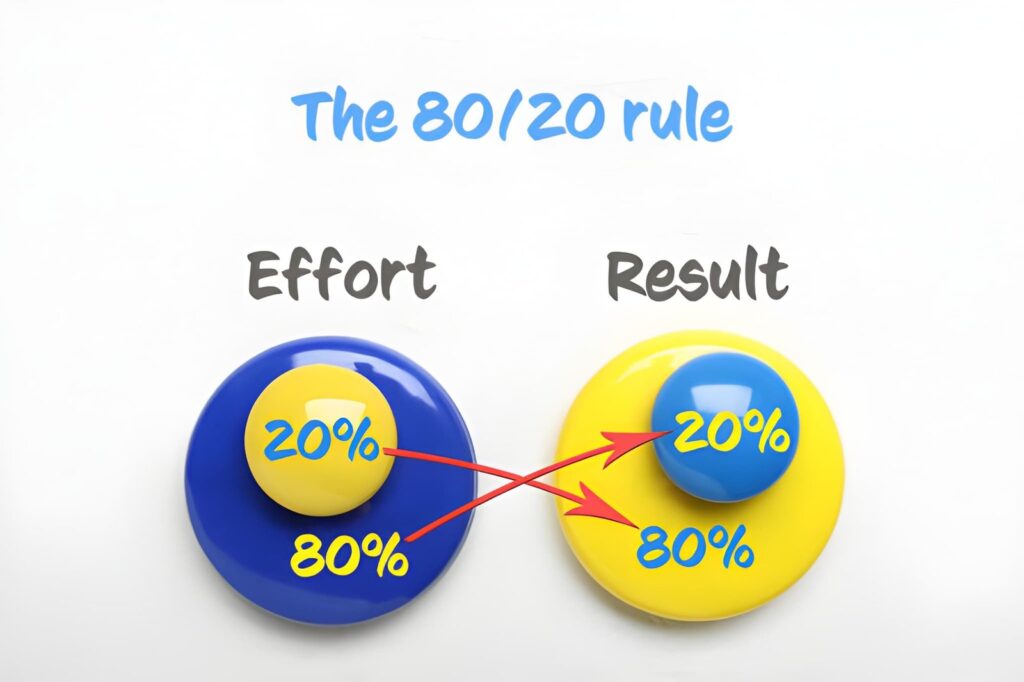
That’s the core principle behind the Pareto Principle, better known as the 80/20 rule. It’s the idea that 20% of your actions yield 80% of your outcomes.
Sounds confusing? Here’s a breakdown of what the Pareto Principle really means, why it works, and how you can leverage it to your advantage.
What Is the Pareto Principle?
The Pareto Principle, commonly known as the 80/20 rule, is a productivity technique that suggests a small part of your effort creates most of your results. Usually, 20% of your actions lead to 80% of your outcomes.
The discovery was made by Vilfredo Pareto, an Italian economist, back in the late 1800s. He noticed that 80% of Italy’s land was owned by only 20% of the people.
This 80/20 split shows up almost everywhere. At work, 20% of the tasks yield 80% of the results. And in business, 20% of clients normally bring in 80% of the sales.
The numbers are not literal. It doesn’t have to be a perfect 80/20. At times, it can be 90/10 or 70/30. But the idea remains the same: a small portion of what you do has the biggest impact.
Why the Pareto Principle Works

How come the Pareto Principle pops up everywhere, from land ownership to business profits? There are a few reasons behind this.
1. Life is Uneven
Life isn’t always balanced, and effort doesn’t always match results. Rewards are rarely spread out evenly.
This unevenness is a reflection of how life works. Not all friends will support you the same way, and not all tasks will bring in the same results. Some blog posts will go viral, while most will get average traffic.
The Pareto Principle uses this imbalance to its advantage. You accept this unevenness and lean into it.
2. Focus on What Matters
Since efforts don’t give equal returns, the Pareto Principle helps you zero in on the few things that really matter. You stop spreading yourself too thin when you focus on things that matter.
For instance, you may have a long to-do list. But using frameworks like the Eisenhower Matrix can help identify your most important tasks and focus on them.
This way, you put your energy where it counts. And the result is bigger progress with less effort.
3. Reduces Wasted Effort
One massive advantage of the Pareto Principle is that it cuts wasted effort. It’s easy to fall into the trap of getting busy instead of being productive.
Instead of chasing everything, you focus on the essentials. You spot the ‘trivial many’ activities and cut back on them.
How to Apply the 80/20 Rule in Life?
Understanding why the Pareto Principle works is one thing. Putting it into practice is another.
Knowing that a few actions create most of your results is only valuable if you use that knowledge to guide your choices.
Here are some ways to apply the 80/20 rule to daily life.
1. Identify the Vital Few
The first step is to identify your ‘vital few.’ These are the small set of tasks and activities that create the biggest impact in your life.
At work, these are the projects and clients that drive the most revenue. In health, it could be the simple daily habits that deliver the bulk of your progress.
You can even apply it in relationships to identify the people who give you the most love and support.
It can be difficult to identify such tasks because they don’t always scream for your attention. Often, they are drowned by the ‘trivial many’ tasks.
But once you do, your perception changes. You realize you don’t need to do everything, but only the few things that matter.
2. Cut Back on Trivial Many
After identifying the ‘vital few,’ you now need to cut back on the ‘trivial many.’ These are tasks and habits that eat up your time without giving much in return.
Think of all the hours you spend scrolling through social media or saying yes to meetups that don’t really matter. They keep you busy but don’t bring you closer to your goals. These are the ‘trivial many.’
Cutting back doesn’t necessarily mean eliminating them completely. You could delegate or even automate them.
The goal is to stop giving them your time and energy. By doing this, you can free up your space for what truly matters.
3. Track and Measure Your Patterns
It’s important that you know where your time and energy are going. Otherwise, you’ll assume you are doing the right thing when in reality, your efforts are going into low-value tasks.
Tracking your patterns doesn’t have to be complicated. An excellent way is to keep a journal of how you spend your day.
With time, patterns will start to show up. You might realize that only a few of your habits give you the biggest boost.
Applying the 80/20 rule becomes much easier once you see these trends. You’ll now know what to let go of and what to prioritize.
4. Apply it Beyond Work
The Pareto Principle applies beyond work. It is for almost every part of life.
In health, for instance, strict diets and complex workout plans are important, but you may notice that simple habits like walking daily and sleeping well deliver more health benefits.
Or in finances, a small percentage of your income sources account for most of your earnings.
Spotting these things will simplify your life and cut down on unnecessary stress.
Benefits of Using the Pareto Principle
The real value of the Pareto Principle comes into play when you apply it beyond work. Its benefits are wide-reaching and touch almost every part of life.
These are some of its biggest advantages.
1. Clears Priorities
It’s hard to know where to begin when everything feels important. The 80/20 rule cuts through the noise and brings clarity.
Instead of treating every task and opportunity as equal, it allows you to spot the ones worth your time. You stop juggling everything at once and focus on those that are important. This gives you peace of mind and boosts your productivity.
2. Improved Work-Life Balance
On top of boosting productivity, this technique reclaims your time. Since you focus on meaningful activities, you free up space for personal time.
You can now rest, spend time with family, and work on your personal growth. These are areas that we often push aside when stuck in busy mode.
3. Reduces Stress
Stress comes when you feel you’ve got too much to do and not enough time to accomplish it. The 80/20 rule eases this pressure.
It creates breathing room. Instead of getting pulled in ten directions, you now channel your energy into the three or four most important tasks. The result is fewer late nights and more mental clarity.
Limitations of the Pareto Principle
Even as powerful as it is, the 80/20 rule still falls short in a few areas. Here are key limitations to keep in mind.
1. Difficult to Identify the 20%
One of the biggest challenges with the 80/20 rule is figuring out what your ‘vital few’ are. It’s not always obvious which habits or clients are responsible for the bulk of your success.
Sure, you can always track and measure your patterns. But on top of being time-consuming, it’s also easy to misjudge what truly drives results. This makes the Pareto Principle less straightforward and more of an ongoing process.
2. Can Lead to Neglect
Just because tasks don’t deliver massive results doesn’t mean they are not important. For instance, doing household chores may not feel like a high-impact activity, but letting it slip can create a bigger problem down the road.
Likewise, responding to customer inquiries may not directly generate massive profits, but ignoring them could harm your reputation.
‘Low impact’ isn’t the same as ‘no impact.’
3. Not a One-Time Fix
Pareto Principle isn’t a one-time fix-it project. It’s not something that you apply once and forget. Life and personal goals are constantly evolving. And what counts as 20% today may be different a year from now.
This means you need to re-evaluate your patterns regularly and adjust your focus. Like a map, the 80/20 rule guides you, but you need to keep recalibrating it.
Mistakes People Make with the 80/20 Rule
Like most things, the 80/20 rule works only if you get it right. We’ve outlined almost everything to know about the rule, apart from one vital thing: the mistakes you need to avoid.
To get the best of this technique, beware of these common mistakes people fall into:
Only using 20% of Your Time
It’s 20% of your tasks, not time. The principle applies to outputs/results, not the literal time spent.
Many people believe they should only work 20% of the time and neglect the rest. The principle isn’t an excuse to slack off.
Maintain your work rate but focus your efforts on the tasks that bring in the biggest results.
Treating Everything at the Vital 20%
It’s easy for everything to feel urgent and important. And in such a case, you risk losing the clarity that the rule is meant to bring you.
But this also doesn’t mean that you should dismiss the 80% altogether. Many of these smaller tasks are necessary to keep things running smoothly.
Not Updating Your 20%
The final mistake is assuming your 20% will always remain the same. Circumstances change and priorities shift. If you don’t review and adjust your plan regularly, you may end up focusing on outdated tasks that no longer drive results.
A Mindset Shift
The 80/20 rule creates space for better results with less effort. Sure, it takes practice to avoid common pitfalls and identify your true 20%, but the payoff is worth it. Success isn’t always about doing more; it’s about doing what matters the most.