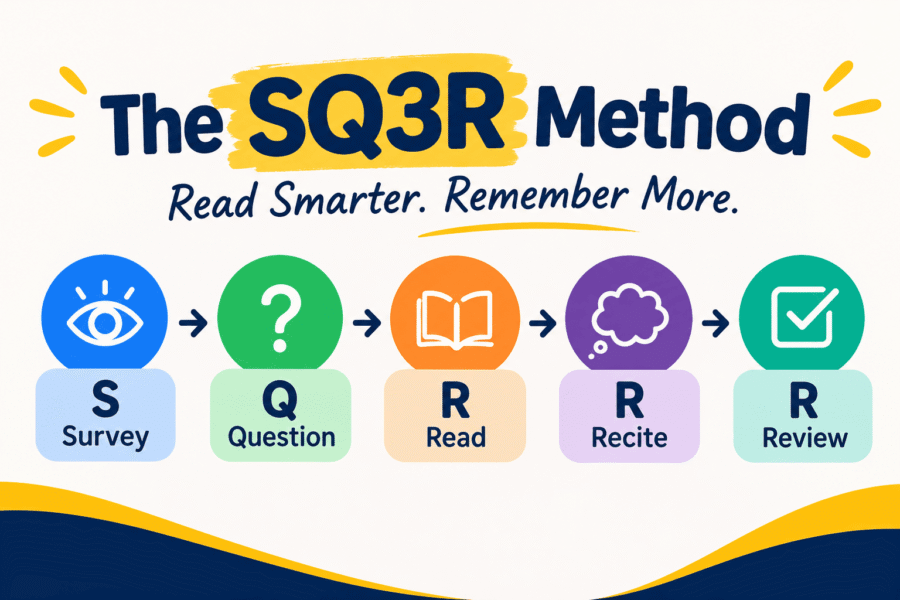
Not all study methods are equal.
Some make you feel like you’re learning since you spend hours reading and highlighting, while others actually help the information stick long after you’ve closed the book.
The SQ3R is in the latter. It guides you through a structured process that keeps your brain engaged from beginning to end.
Here’s a beginner’s guide to SQ3R: what it is and how you can use it to learn faster and remember more.
What Is the SQ3R Method?
SQ3R stands for Survey, Question, Read, Recite, and Review. It is a study technique that helps you remember what you read. Each of the five steps build on the one before it and help you be actively involved with the content.
The method was developed in 1946 by educational psychologist Francis P. Robinson. His aim was to help students learn more effectively from textbooks.
The SQ3R method makes reading an interactive process. You don’t let information wash over you. Instead, it challenges you to question, predict and recall what you’ve learned.
Who Should Use the SQ3R Method?
Although the SQ3R method is often associated with students, it’s not limited to the classroom. It’s applicable to anyone who needs to understand and retain information from written material.
You’ll find it useful if you’re a:
- High school and college student who constantly engages with lengthy textbooks.
- If you’re studying for final exams, entrance tests, or professional certifications.
- Professional trying to learn and acquire a new skill.
- Researcher trying to decipher an information-heavy material.
- Lifelong learner learning new material out of curiosity.
The SQ3R method isn’t reserved for a specific profession or age group. It is a practical strategy for anyone who wants to remember and apply what they’ve learned.
The Five Steps of the SQ3R Method
The SQ3R method is simple, but you must follow its steps systematically for it to work. Each stage has a specific purpose, and together, they create a useful and effective study process.
1. Survey
Before you begin reading, you need to get the lay of the land. This means spending a few minutes skimming the article or chapter to understand how it’s organized.
It’s like looking at a map before you set off on a journey. You don’t know every turn yet, but you have a good idea of where you’re headed.
Pay attention to the title and headings as they reveal what you’ll be learning about. Check for any summaries, charts, diagrams, tables and italicized terms. You can also take a quick look at review questions and conclusions.
You are not trying to memorize everything at this stage. It’s more of building a mental framework for the information that you’re about to consume.
By surveying, you also identify sections that may require extra attention.
This step may only take a few minutes, but it makes the rest of the process much easier.
2. Question
Once you’re done surveying the material, it’s now time to turn on your curiosity.
Ask yourself questions about what you’re going to learn. For example, if you’re learning about ‘Climate Change,’ you might ask yourself:
‘What causes climate change?’ and ‘what are the effects of climate change?’
This way, you give your brain a clear purpose and make it easier to focus and recognize information as you read.
Ask questions about everything: headings, unfamiliar terms and concepts and diagrams that caught your attention during surveying.
The more engaged you are before you start reading, the more likely you are to stay interested throughout the chapter.
3. Read
Now, it’s time to read, though in a different way from how you normally would.
When reading, focus on finding the answers to the questions you’ve asked. It gives you a clear objective and makes reading much more meaningful.
Slow down when you encounter concepts that don’t make immediate sense. Pause for a moment instead of pushing and hoping that it becomes clearer later.
Underline key points and jot down short notes. Aim for ideas that directly answer your questions or those that explain the main concepts.
4. Recite
After you’re done reading, close the book and try recalling what you just learned from memory. Challenge yourself to see how much you can remember.
Explain ideas in your own words. Imagine you’re teaching the topic to someone who’s never heard of it before.
Being able to explain a concept without looking at the text is a good sign that you’ve understood it.
Don’t worry if you struggle to remember something. That’s part of the process. You’ve spotted a gap in your understanding before it becomes a bigger problem.
Go back to the material, review the parts you missed, and try again.
You strengthen your mental pathways every time you retrieve information from memory. This makes it easier to recall later.
5. Review
You can understand a topic perfectly well today, but unless you revisit it, you’ll likely forget much of it over time.
Go over your notes periodically and review what you learned. Try answering those questions again without looking at the textbook, and see how much you can still recall.
Certain topics will feel shaky. Spend a little extra time reviewing these rather than rereading the entire chapter.
Space out your review sessions instead of doing them all at once. Revisit the material after a day, then a few days after that, and again before an exam. This gives your brain multiple opportunities to strengthen these memories.
Why the SQ3R Method Works
The SQ3R method has stood the test of time because it’s built around how people learn. It encourages active learning and doesn’t treat it as a passive activity.
Here are some benefits of the learning method.
1. Encourages Active Learning
The SQ3R method method turns you from a passive reader into an active learner.
You don’t simply read page after page. Instead, you’re constantly asking questions, searching for answers and trying to recall information. Each step challenges you to engage with the material instead of just looking at it.
Your mind is engaged and doesn’t drift away after a few pages. You continually interact with the content which makes studying feel more purposeful.
2. Improves Reading Comprehension
It’s common to read without truly understanding what you’re reading. It’s only after reaching the end of the chapter that you realize you can’t remember how different concepts connect.
The SQ3R method eliminates this through its different stages.
You begin by surveying to give your reading a clear purpose. Then the recite and review stages strengthen your comprehension even further. Explaining a concept in your own words forces you to process its meaning.
As a result, you finish a chapter with a much deeper understanding of the material.
3. Boosts Long-Term Memory
The SQ3R method makes you interact with a material multiple times through questioning, reading, reciting, and reviewing. Each interaction gives your brain another opportunity to encode the information.
This makes it easier to store and retrieve it later.
The recite and review stages are especially powerful since they rely on active recall.
4. Helps You Identify Key Ideas
Not every material carries the same weight. The SQ3R method helps you separate essential information from supporting details.
You create questions before you read and naturally begin looking for concepts that answer those questions. This gives your reading direction and helps important ideas stand out.
It becomes easier to recognize themes and identity which information requires more attention.
5. Makes Studying More Efficient
The SQ3R method helps you study with intention. It reduces the need for constant rereading by helping you understand and remember the material the first time around.
You know what you’re looking for, and you waste less time passively reading without understanding anything.
Limitations of the SQ3R Method
While the SQ3R method is an excellent study strategy, it’s not perfect. Knowing its limitations will help you decide when to use it and when to opt for something different.
1. Takes Longer Initially
The SQ3R is slow at first. Surveying the material, creating questions and reciting from memory all add extra steps to the study process.
But this time is an investment rather than a drawback. You get to understand more during your first study session, and likely spend less time rereading the material later.
The process becomes quicker and more natural with time.
2. Less Effective for Casual Reading
Stopping to create questions or review each section may not be ideal if you’re reading a novel for entertainment or browsing a magazine.
The method is valuable when your goal is to learn and remember information. The extra effort pays off for textbooks and educational materials, not reading for recreation.
3. Requires Consistency
The SQ3R method only delivers the best results when you use it regularly. Using it once or twice may improve a single study session but the real benefits come from making it part of your routine.
Building it into your regular study routine makes each study session more productive over time.
Better Reading Sessions
Sure, the SQ3R method takes longer than simply reading a chapter from start to finish. After all, you’re surveying, questioning, reciting, and reviewing in addition to reading.
But through these processes, it transforms reading from a passive activity into an active learning experience. It improves both comprehension and retention.
The next time you’re about to study, resist the urge to read from beginning to end without a plan. Try the SQ3R method instead.