You finish a chapter, and for a moment, you feel smarter. But then someone asks what you’ve learned, and your brain suddenly goes blank. It happens more than most people like to admit.
The Feynman Technique is designed to help with this. It asks a simple question: Can you explain a topic in a way a child would understand?
If the answer is no, then you likely don’t understand it yourself.
Here’s everything you need to know about the technique, and why people swear by it for learning almost anything.
What Is the Feynman Technique?
The Feynman technique is a learning method based on the idea that if you can’t explain something in simple terms, then you probably don’t understand it.
It means there’s probably a gap somewhere and you need to go back to it.
Instead of memorizing, the technique asks you to explain a topic as if you were teaching someone with zero background knowledge, perhaps a child or a friend.
Once you begin to struggle or overcomplicate things, you’ve found what you still need to learn. That uncomfortable moment is where real understanding begins.
The technique is named after Richard Feynman, who was an American theoretical physicist. He was known for breaking down topics and explaining complex concepts in plain language.
Thanks to him, knowing something wasn’t about sounding smart, but being able to explain it simply.
Who Should Use the Feynman Technique?
The Feynman technique isn’t just for students cramming for exams. It’s useful for anyone trying to understand something well enough to remember it.
1. Students
Students are probably the most obvious group. They study for hours and then forget everything under the pressure of exams.
The Feynman technique moves information from ‘I’ve seen this before’ to ‘I can comfortably explain this without my notes.’
2. Professionals
Learning continues even after school. People pick up industry knowledge all the time.
The Feynman technique makes workplace learning easier, especially when dealing with complicated information.
When you understand something deeply, you can better explain it to your clients or boss.
3. Learning New Skills
Trying to learn coding or a language?
New skills often come with confusing terminology. Explaining concepts in simple terms forces you to understand instead of memorize.
4. Lifelong Learners
If you enjoy reading books or watching educational videos, the Feynman technique can help you retain more of what you consume.
How the Feynman Technique Works (Step-by-Step Guide)
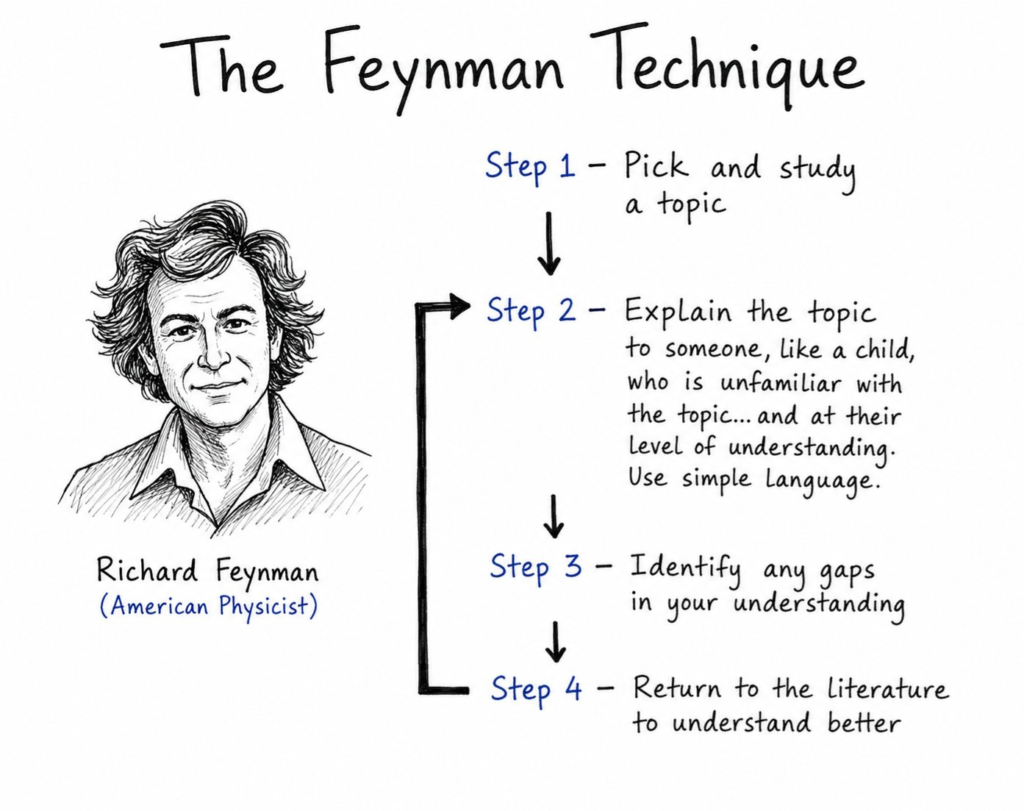
The technique sounds simple in theory, but what does it look like in practice?
Thankfully, you don’t need special tools or expensive courses to master it. Here’s how the process works.
Step 1: Choose a Concept You Want to Learn
Choose a topic you want to learn. Not a textbook chapter or an entire subject. Just one topic and keep it specific. For example, photosynthesis, supply and demand, or compound interest.
Keeping the concept narrow makes it easy to identify what you understand and where you get stuck.
Write the topic on a blank page as if you’re preparing to teach it. This shifts your brain from consuming information to explaining it.
Step 2: Explain It Like You’re Teaching a Child
The next step is to explain the concept you chose in the simplest way possible.
Imagine you’re having a conversation with someone with no background knowledge. Avoid complicated terms where you can.
The point isn’t to dumb things down, but to prove to yourself that you understand the idea well enough to remove the complexities.
Pay attention when you catch yourself relying heavily on textbook jargon and definitions. That usually means something is amiss.
Step 3: Identify Knowledge Gaps
A knowledge gap is when you catch yourself pausing and thinking, ‘I don’t know how to explain this part.’
Strangely enough, this is one of the most useful parts of the entire process. While most study techniques make it easy to overlook weak areas, the Feynman technique puts them right in front of you.
It makes you notice where explanations become vague and where you skip details.
Don’t see these gaps as failure. Instead, treat them like directions. They show you what needs more attention.
Step 4: Return to the Source Material
After finding the confusing parts, go back. Resist the urge to guess your way through them.
Open your notes and re-read the chapter. Watch the lesson again and look for explanations from other sources if necessary.
You are searching for answers to specific gaps. Because you already know where your understanding broke down, this new information is likely to stick more easily the second time around.
Step 5: Simplify and Refine Again
Once you review the material, try to explain the concept again from the beginning. This time, your explanation will feel clearer and smoother.
You’ll notice you can rewrite it better and without unnecessary complexities. You may even be able to use examples.
It may take a couple of repetitions to fully understand a concept, and that’s fine. You don’t have to get it perfectly on the first try.
The goal is to refine your understanding until the explanation feels natural.
Benefits of the Feynman Technique
The advantages of the Feynman technique extend beyond studying. It changes how you learn, remember information, and even communicate with other people.
Here are some of its biggest advantages.
1. Helps You Understand
Memorizing information gets you through a test; understanding it helps you keep it.
The Feynman technique pushes you beyond repeating facts and toward explaining ideas in your own words.
This shift leads to deeper learning because you are processing information instead of copying it.
2. Improves Long-term Memory
Explaining concepts forces your brain to actively process information. As a result, it becomes easier to remember later. Learning becomes more involved and less passive.
Your brain puts a lot of effort into understanding something, which makes it harder to forget.
3. Makes Studying More Efficient
Studying for longer hours doesn’t always mean learning more.
The technique reveals where you are struggling, so you can spend less time reviewing things you already know and more time fixing weak spots.
It’s a targeted approach that saves time.
4. Improves Communication
It may not seem obvious at first, but the habit of simplifying complex ideas makes you a better communicator overall. People who understand topics well often explain them better.
Test Your Understanding
Most of us struggle, not because we don’t study enough, but because we rarely test whether we understand what we’ve studied.
The Feynman technique pulls you out of passive learning and forces you to be more honest. In the end, you become better at explaining ideas in simple language and finding where your understanding breaks.
Instead of asking, “Have I studied this enough?” it might be more useful to ask:
“Can I explain this simply enough that someone else would actually understand it?”