You can spend hours studying and still forget most of what you learned.
Not because you didn’t study long enough, but because you studied in a way that made information feel familiar instead of making it stick.
Active recall takes a different approach. Instead of reviewing information passively, it tests your memory by recalling what you’ve learned without looking at the answers.
Here’s everything you need to know about this study technique.
What Is Active Recall?
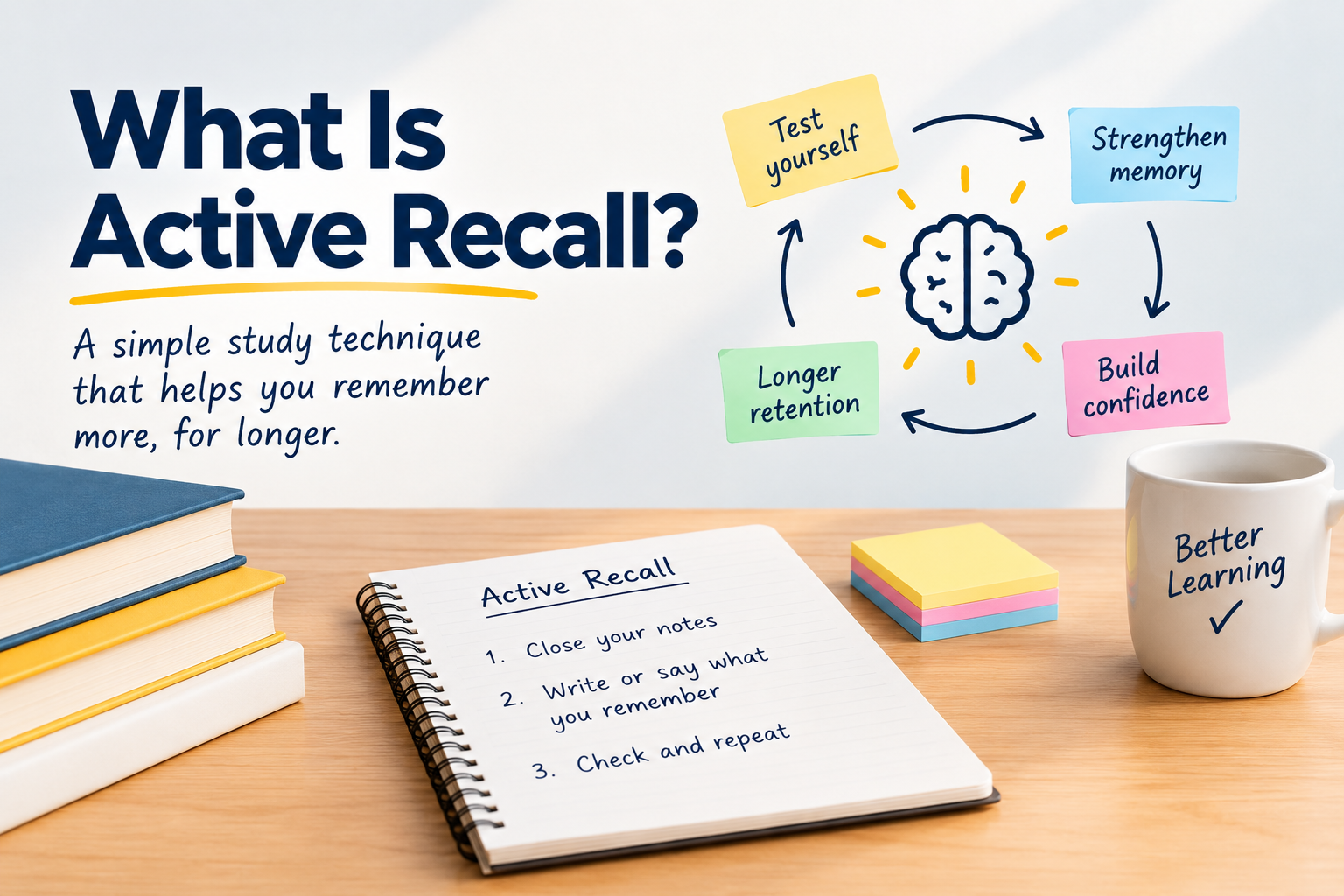
Active recall is a learning technique where you retrieve information from your memory without looking at your notes.
You challenge yourself to remember what you’ve learned first, before checking to see what you got right and what you missed.
After completing a chapter, you close the book then write down everything you remember. If you’re using flashcards, try answering the question before flipping the card over.
The goal isn’t to get every answer correct. If anything, struggling to remember is part of the process. It signals where you need to revise more.
Sure, active recall takes a bit more time and effort, but it does a much better job of helping information stick long after you’ve finished studying.
Ways to Practice Active Recall
Active recall doesn’t require any complicated tools or systems to use it. What’s important is that you rely on your memory instead of copying information from the page.
Here’s how to incorporate it in your daily study routine.
1. Close Your Notes and Explain What You Remember
An easy way to practice active recall is to put your notes aside after completing a chapter or a section, then try to explain what you’ve learned from memory. The goal is to see how much you can remember.
You can either write down what you remember or speak out loud like you’re teaching someone else.
Once you’re done, compare your explanation with your notes to see what you remembered correctly and where the gaps are.
Use the forgotten details as an indication of what needs more attention.
2. Use Flashcards
Flashcards are popular with active recall because they force you to retrieve information before checking the answer. This repeated retrieval strengthens your memory and makes the information easier to remember over time.
If you get a card wrong, review the correct answer and come back to it later instead of moving on and forgetting about it.
3. Answer Practice Questions
Practice questions require you to apply what you’ve learned without relying on your notes. They are especially useful when preparing for exams or professional certifications.
Understanding why an answer is right or wrong is just as important as getting the answer itself.
4. Teach Someone Else
The Feynman technique teaches that if you can’t explain a concept in a way a 5-year old would understand, then you likely don’t understand it.
Teaching means you have to organize your thoughts and recall what you learned then explain it in a way that makes sense.
Talking through the material, you quickly notice the parts you’re unsure about. These are the areas worth reviewing before moving on.
5. Use Active Recall With Spaced Repetition
Active recall becomes even more effective when you combine it with spaced repetition.
Spaced repetition spreads your review sessions over days or weeks. This way, you revisit concepts just before you’re likely to forget them.
The increased intervals help move information into your long-term memory.
Benefits of Active Recall
Active recall doesn’t just sound good on paper. It’s effective since it helps you remember information instead of simply recognizing it.
Here are some of its biggest advantages.
1. Improves Long-Term Memory
A big advantage of active recall is that it makes information stay with you for long, especially when used with spaced repetition.
You strengthen your memory every time you retrieve something from memory and make it easier to remember in the future.
2. Makes Studying More Efficient
Active recall makes better use of your study time by focusing on retrieval rather than repetition. It helps you spend less time reviewing what you already know and more time on areas that need attention.
3. Reveals What You Don’t Know
It’s easy to assume you’ve mastered a topic simply because it looks familiar on your notes. But once you start explaining them from memory, gaps begin to expose themselves.
Now you can focus your efforts on improving these instead of reviewing everything equally.
4. Works for Almost All Subjects
Active recall isn’t limited to school. It can be used to remember historical events, learn languages or even memorize presentations. It can be used by anyone trying to learn anything more effectively.
Tips for Getting the Best Results With Active Recall
You’ll make the most of active recall if you use it consistently as part of your routine. Here are a few habits to make the most out of this technique.
1. Study in Short Sessions
Long study sessions will likely leave you mentally drained and make it harder to remember what you’ve learned.
Break your study time into pomodoros with regular breaks in between. This helps you stay engaged and gives your brain time to process the information.
2. Focus on Understanding First
Active recall is only effective if you understand the material before trying to memorize it. If a concept doesn’t make sense, simply testing yourself over and over is unlikely to help.
Learn the idea first, then use active recall to strengthen your memory of it.
3. Review Mistakes Regularly
Getting an answer wrong is part of the learning process. Every mistake exposes where your understanding is weak. This should give you a clear direction for what to review next.
Turning mistakes into learning opportunities is an excellent way to improve your memory.
4. Be Consistent
Like any skill, active recall is most effective when you practice it regularly. You’re better off studying a few minutes several times a week instead of one long session.
Consistency helps move information into your long-term memory.
Make Every Study Session Count
How you study makes a huge difference. Active recall shifts your focus from passively reviewing information to actively retrieving it. It helps you remember more and makes better use of your study time.
The next time you’re done studying, close your book, and test your memory. You might be surprised by how much you remember.