The workplace is changing fast with AI on the rise and remote work becoming increasingly common. Titles no longer impress, and employers are looking for creators and problem-solvers.
Relying on traditional career paths will get you left behind. Workers who survive are those who can adapt and bring something different to the table.
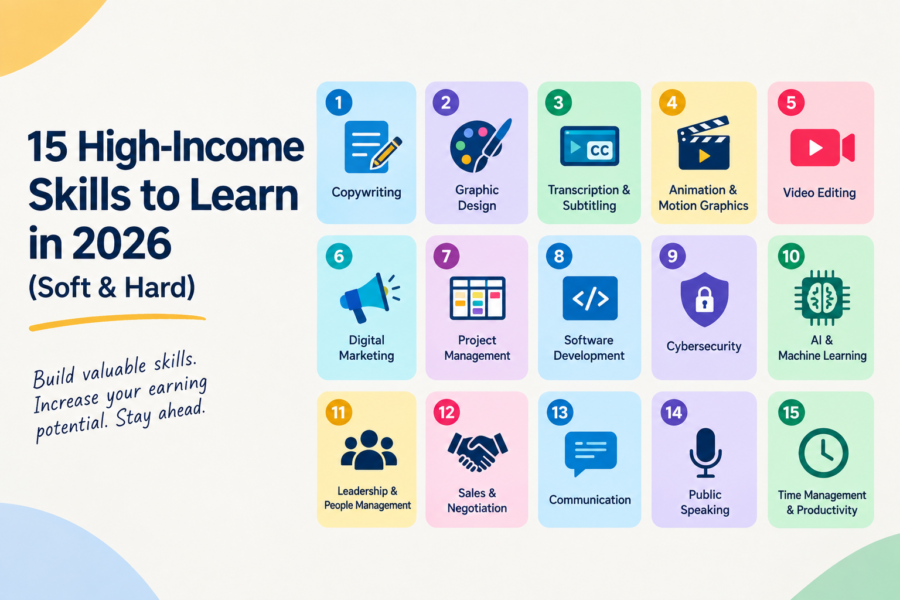
Let’s explore 15 of the most in-demand high-income skills for 2025, both hard and soft, that will grow your income and keep you ahead of the curve.
You can pick up many of these skills online and monetize them as side gigs.
Hard Skills
Hard skills are the teachable, technical abilities you can test and prove. They focus on what you can do, and you can learn them through courses and certifications.
Given that so much of our work is now happening online, hard skills are fast becoming a must-have.
1. Copywriting
Yes, copywriting is at the top of the list because I’m a writer, but also because great copy sells. It’s one of those skills that look simple on the surface but run deep once you get into it. And mostly because it’s a mix of creativity and psychology.
You are not just writing beautiful sentences, you are figuring out what people care about, what keeps them up at night, and then showing them how a product or service solves that.
Companies know this, and that’s why they will pay generously for someone to write words that bring them business.
The best part is that you don’t need a degree or years of experience to start. A bit of curiosity and the willingness to learn is enough to make you improve quickly.
Before you know it, you’re using it to make money.
2. Graphic Design
Every logo you recognize and every Instagram post that made you stop scrolling, someone designed it. Businesses rely heavily on how they look online and offline, and that’s why graphic designers remain in demand.
If you can help a startup or solo creator look professional and eye-catching, you’ll never run out of work.
Graphic design is flexible, and tools like Figma and Canva have made it way more accessible. You can go deeper with motion graphics and charge premium rates just for making things look pretty.
3. Transcription and Subtitling
Transcription may not get the same hype as writing and graphic design, but it’s another solid freelance skill.
Think about how much content people consume daily – from YouTube and podcasts to online courses and webinars. All those need to be made more searchable and accessible through subtitling.
Sure, AI can spit out a rough transcript, but it’s not as accurate as humans, especially with accents and background noise. And the cool thing is that transcription is an easy skill to learn. All you need is a good ear and attention to detail.
Once you’re good at it, you can level up by offering specialized services like legal or medical transcription and make a decent income.
4. Animation and Motion Graphics
Unlike transcription, animation requires a steep learning curve. It demands time, patience, and real technical skill. Those cartoons in explainer videos that glue you to the screen require a lot of work.
That said, the payoff is huge. If you are willing to put in the hours to learn it, this is a skill that will easily separate you from the crowd. It’s not the easiest path, but that’s why it’s valuable.
5. Video Editing
Given that video is the language of the internet now, video editing has exploded in demand. Every brand wants to turn their story into content that people want to watch. But not everyone has the skill to do it.
Editing is a broad field and ranges from trimming clips for Shorts and TikToks to creating long-form YouTube content and documentaries. It has an entire spectrum of opportunities depending on how far you want to take it.
Of course, the longer the video, the more technical it gets, but also, the higher your earnings.
6. Digital Marketing
Digital marketing is a massive playing field. On one end, you are in SEO, researching keywords and climbing search ranks, and on the other, you are building a social media campaign to convert readers into buyers.
How much money you can make as a digital marketer depends on the results. You are likely to make more if you can show a business that you are able to bring them traffic and leads, and that you’re not just another freelancer.
Businesses will always pay well those who bring real value and can help them grow.
7. Project Management
Behind every successful project is a professional who organizes the chaos. They hold everything together, making sure that budgets don’t get blown and deadlines are met. Without them, teams will start pointing fingers.
Project management is especially valuable today now that work is more global and remote. Businesses are juggling multiple priorities at once and teams are scattered across time zones.
Companies need people to keep everything aligned and ensure results are delivered on time.
The upside is that you don’t need to be a CEO to practice project management. Even managing small projects like a personal blog gives you a taste of the skill.
Businesses will pay you handsomely if you can take a messy idea and guide it to the finish line.
8. Software Development
Graphic design shapes how a brand looks, but web development decides how it works. Almost every business, big or small, needs a digital home.
It could be a simple website, a custom app or a full-blown e-commerce store. A software developer makes all this happen, making the skill one of the most bankable out there.
Given that AI tools can spin up a full website and a functioning app in a matter of minutes, developers should be out of work, right?
Not quite. The human touch matters now more than ever. AI generates the skeleton, but it’s human developers who breathe life into it. They fix bugs and make sure everything works as it should.
As a developer, you can freelance or work with startups. It’s one of the skills that pays well and gives you the freedom to choose how and when you work.
9. Cybersecurity
With everything moving online, governments and businesses are constantly under threat. One unpatched system and all sensitive data is at risk of landing in the wrong hands.
Those who can stop this from happening, or step in when it does, are some of the most sought-after professionals in tech.
For example, Apple offered a $2 million bug bounty to whoever can uncover serious vulnerabilities in its systems. Yes, that’s how high the stakes are.
Cybersecurity is a powerful skill because it’s not going anywhere. AI is creating new risks and hackers are getting smarter. If anything, cybersecurity professionals are becoming even more valuable.
10. AI & Machine Learning
Artificial intelligence is here, shaping nearly every industry. Businesses are leveraging it to streamline their operations and make decisions at scale.
And while AI can do so many things faster and better than humans, it still lacks our emotional intelligence and ethical judgment.
That’s why machine learning is important to ensure tech complements and doesn’t replace human creativity and critical thinking.
Soft Skills
Soft skills are the human-centered abilities like communication, problem-solving, and emotional intelligence.
Unlike hard skills, which you learn through education and training, soft skills are more about how you interact with others.
They are the skills AI won’t replace any time soon, and are becoming more valuable as workplaces automate almost everything.
11. Leadership & People Management
Leadership is less about sitting at the top of the food chain and barking orders and more about relating to people. It’s about knowing how to motivate and guide your workers, and at times, even protecting them.
People management takes it further by resolving conflicts amicably and ensuring the team enjoys working for the company.
Of course, these are skills that take time to learn. But once you have them, they are valuable everywhere; from running your own business to leading teams in big companies.
12. Sales and Negotiation
We are all selling something; whether a product or our skills. But sales has a bad rap because many people imagine a pushy sales guy who won’t let you leave until you buy their product.
But real sales is quite the opposite.
As a salesperson, it’s your duty to figure out what people care about and connect the dots between their needs and your product. When done right, sales feels like you are helping and not selling.
When you’ve mastered the art of closing deals, businesses will want you in rooms selling their products.
13. Communication
Almost every successful person is a good communicator. By communication, I don’t mean speaking clearly per se, it’s more about explaining ideas without losing people. You are able to listen and adapt your message depending on who’s in front of you.
You may be the smartest person in the room, but unless you can communicate properly, your ideas remain stuck in your head.
At a time when most of our work conversations happen over email and project management tools, being able to get your point across clearly is worth more than ever.
14. Public Speaking
Not many people are comfortable speaking publicly, and that’s why the skill pays off. You set yourself apart if you can stand in front of a group of people, and deliver your message with confidence.
You don’t need to be perfect, or have a booming voice, you need to connect with your audience, hold their attention, and leave them with something they’ll remember.
Your ability to speak well in public means you can pitch to investors or give a keynote that inspires an entire room. And that is a life skill that will open so many doors for you.
15. Time Management & Productivity
We all have limited time, and how you use yours determines pretty much everything else. A good time manager knows what matters (and what doesn’t) and has the discipline to stick to it.
When you master time management, you stop being busy all the time and start feeling productive. And it will surprise you just how much you can get done.
A Blend of Both
Just because AI can draft emails and write bits of code in seconds doesn’t mean it will replace the human touch. These skills are still valuable in so many industries.
Soft skills will connect you to the right people while hard skills will give you the technical firepower to solve problems. Put the two together and you become someone AI can’t compete with.
Invest in these high-income skills and you’ll remain valuable and relevant in a world that’s changing faster than ever.