As a team, having ideas is great. Having too many ideas can be incredibly stressful.
You’ve got great ideas, good ideas, and really bad ones too.
But staring at them, they all make sense. All of them could work, and this somehow makes it worse. With limited time, which one should you work on and which one should you ignore?
The RICE Scoring Model is built to fix this: A prioritization system that quantifies your thinking.
Here’s a breakdown of everything you need to know about the RICE Scoring method.
What Is the RICE Scoring Model?
The RICE Scoring Model is a prioritization framework designed to help users decide what to work on first. It compares ideas objectively so you can focus on the work that delivers the most value using the least effort.
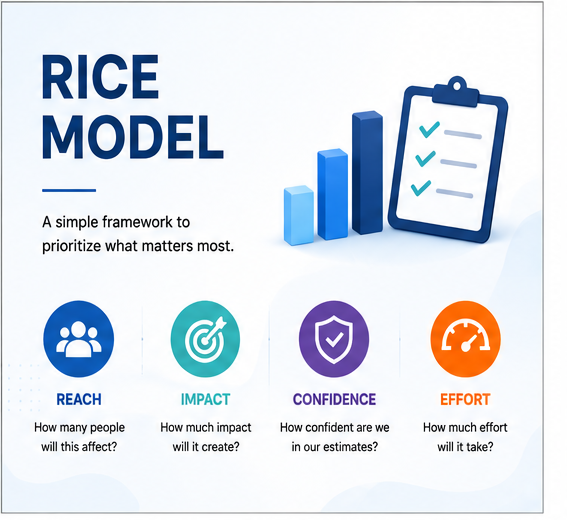
It comprises four factors:
- Reach: How many people will the idea affect in a specified time frame?
- Impact: If it works, how big will the outcome be?
- Confidence: How sure are you about the estimates?
- Effort: How much time and resources does it need?
The model was popularized by the Intercom product team. They wanted a better way to decide which features to build on without getting stuck in back-and-forth debates.
It has since been widely adopted in startups, marketing teams, and product management.
RICE Score is calculated using the formula:
RICE Score = (Reach × Impact × Confidence) ÷ Effort
Components of RICE
Each of the four components of RICE plays a specific role. If misunderstood, the final score becomes misleading.
Reach
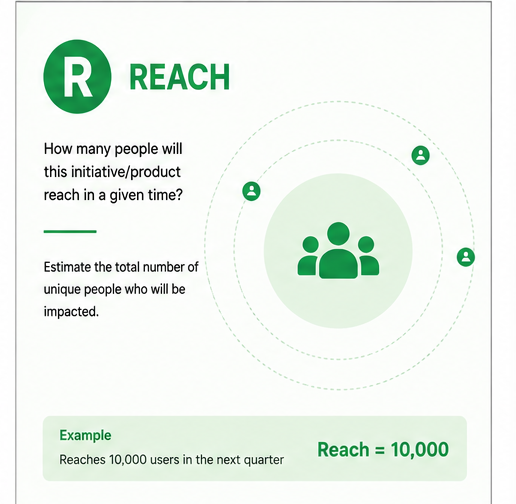
Reach answers the question:
How many people will this initiative impact within a defined time period?
It’s important that there is a timeframe.
For example, 5,000 users a month will use this feature, or 30,000 visitors a month will land on this page.
That’s reach. It’s about exposure and frequency. How many users will realistically touch this change?
Impact
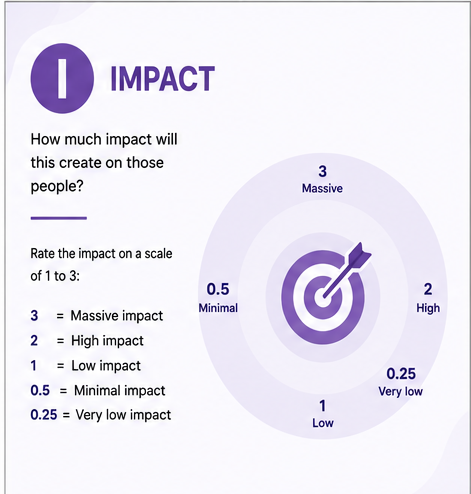
If reach tells you how many people are affected by the change, impact tells you how strongly.
It measures depth rather than size.
Impact is normally scored on a scale like:
- 1 = Low
- 2 = Medium
- 3 = High
- 4 = Massive
It’s easy to confuse excitement with impact. Just because a feature feels innovative doesn’t mean it materially changes outcomes.
Confidence
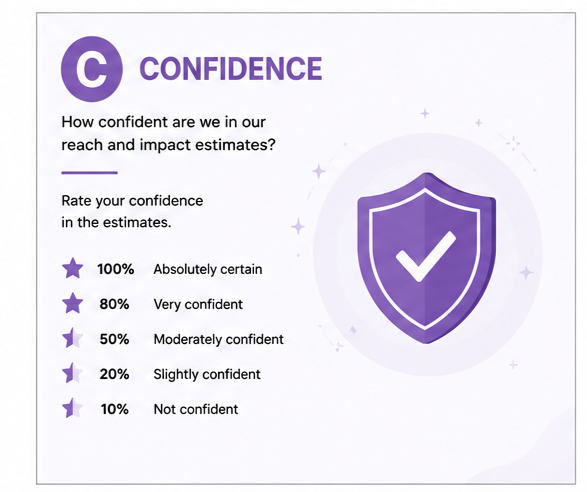
Confidence is the reality check. It’s how certain you are about your reach and impact assumptions.
Typical scoring looks like this:
- 50% for an educated guess
- 80% for good directional evidence
- 100% for strong data and reliable research
Confidence prevents wishful thinking from dominating your roadmap. It rewards validated ideas and penalizes speculation.
Effort
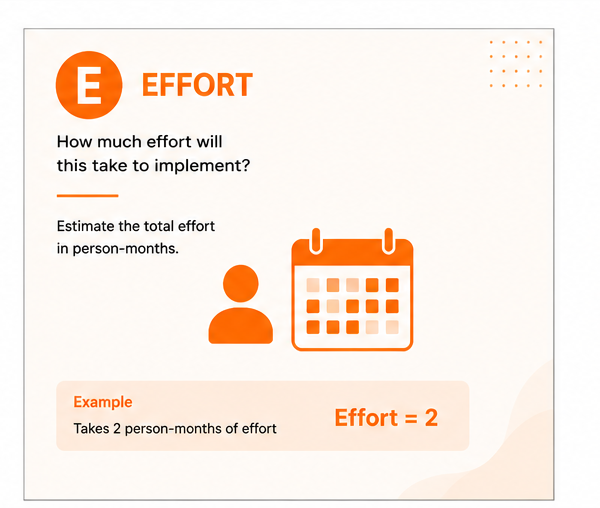
Effort is the total amount of work needed to execute the initiative. It’s normally estimated in person-weeks and person-months.
Effort is the denominator in the formula. That means a higher effort reduces the final score.
Who Is It For?
The RICE Scoring model is for anyone who has to decide what gets done first. It is especially useful for people juggling too many ideas with too little time.
If two ideas produce similar value but one takes half the time, the quicker one should win.
Startup Founders
Startup founders are constantly juggling fundraising, product improvements, and hiring among others.
RICE helps you chase what moves metrics instead of what’s exciting.
Product Managers
As a product manager, every feature request feels important. Customers want one thing, sales want another. And engineering won’t stop reminding you of the technical debt to fix.
RICE gives you a structure to compare ideas without turning every discussion into a debate.
Content and Marketing Teams
Editorial and marketing teams can use RICE to prioritize campaigns based on projected reach and impact.
- What blog posts should you write first?
- Which content updates matter the most?
It makes you stop writing based on vibes and start prioritizing potential return.
Who It’s Not For
As helpful as it is, RICE isn’t ideal in every situation:
- Early stage projects with zero data.
- Creative projects that you are experimenting with.
- Long term bets where impact isn’t yet quantified.
- Crisis situations that require immediate action.
Why the RICE Scoring Model Works
RICE forces friction, and that’s why it works. It doesn’t let you hide behind vague terms like ‘big opportunity’ or ‘high priority.’ It makes you quantify what you mean.
Here’s why it holds up.
1. Makes You Define Impact
You may think a project will have a huge impact. But how huge is it?
RICE makes you specify this impact. Are we talking revenue? Conversions? Or user satisfaction?
You define what success looks like when you assign an impact score. Such clarity can change how a team thinks.
2. Balances Ambition With Reality
You may have a bold and exciting idea with promising results. But what happens when you factor in effort?
Dividing by effort is the quiet genius of the RICE formula.
It makes you prioritize initiatives that produce meaningful results without draining months of resources.
At the end of the day, is it worth the cost? This trade-off is where smart prioritization happens.
3. Reduces Bias
If not for structure, your decisions would be influenced by the loudest voice in the room, internal politics and personal attachment to an idea.
RICE introduces a neutral reference point. It makes reasoning visible. Such visibility is easier to challenge constructively.
4. Exposes Weak Assumptions
The RICE model makes assumptions visible. The entire system is based on data and you’ve got to prove everything.
This isn’t to punish ambition. But rather to discount uncertainty. As a result, it protects teams from overcommitting to ideas built on optimism alone.
How to Use the RICE Scoring Model
The RICE model is an easy one. But it’s also easy to overcomplicate it. Here’s how to use it properly.
Step 1: List What You Are Deciding Between
The first step is to list down the initiatives you are comparing. Write their features, campaigns, experiments, and whatever you are prioritizing.
Make sure they are similar types of work. It wouldn’t make sense to compare ‘hiring a new engineer’ with ‘writing new blog posts.’
Keep it consistent.
Step 2: Define a Clear Time Frame for Reach
The reach only makes sense when it’s inside a window. For instance, how many people will it affect in the next month?
Maybe feature A reaches 300 users per month while feature B reaches 700 users a month. Use this as your starting point.
Step 3: Assign an Impact Score
Use a simple scale to assign an impact score. For example,
1– Low
2– Medium
3– High
4– Massive
Impact is about measurable outcome. Remember, most ideas feel bigger than they actually are.
Step 4: Rate Your Confidence
Honesty is important here. Typical confidence scores look something like:
50%– Educated guess
80%– Reasonable evidence
100%– Backed by strong data
Use this as a reality filter. It adjusts how sure you are that your reach and impact estimates are accurate.
It may humble you, and that’s okay.
Step 5: Estimate Effort
Effort is measured in person-weeks or person-months.
Include the engineering time, design, and content or marketing support.
Teams will always underestimate effort. Double check anything that feels like ‘a quick fix.’
Effort balances ambition with practicality.
Step 6: Run the Formula
Now, it’s time to calculate.
RICE Score = (Reach × Impact × Confidence) ÷ Effort
For example:
- Reach: 1,000 users
- Impact: 2
- Confidence: 80% (0.8)
- Effort: 2 person-months
Score = (1,000 × 2 × 0.8) ÷ 2
Score = 800
Use this for each initiative. The higher the score, the higher the priority. Simple.
You Still Make the Decisions
Don’t expect RICE to make decisions for you. That boils down to you. But it will expose assumptions, reduce bias and bring structure to messy decisions.
Keep your model simple and use it consistently. More importantly, don’t inflate your inputs.
Also remember, RICE isn’t a ‘use it once and forget’ technique. You need to revisit and refine your score as you gather more data.
Prioritization isn’t a one-time decision, it’s an ongoing discipline.