You know you need structure when halfway through a lecture or meeting, you realize you can’t make sense of half your notes.
The outline method of taking notes fixes this. It’s a clean and logical way to quietly bring order to the mess.
Here’s all you need to know about this note-taking technique.
What Is the Outline Note-Taking Method?
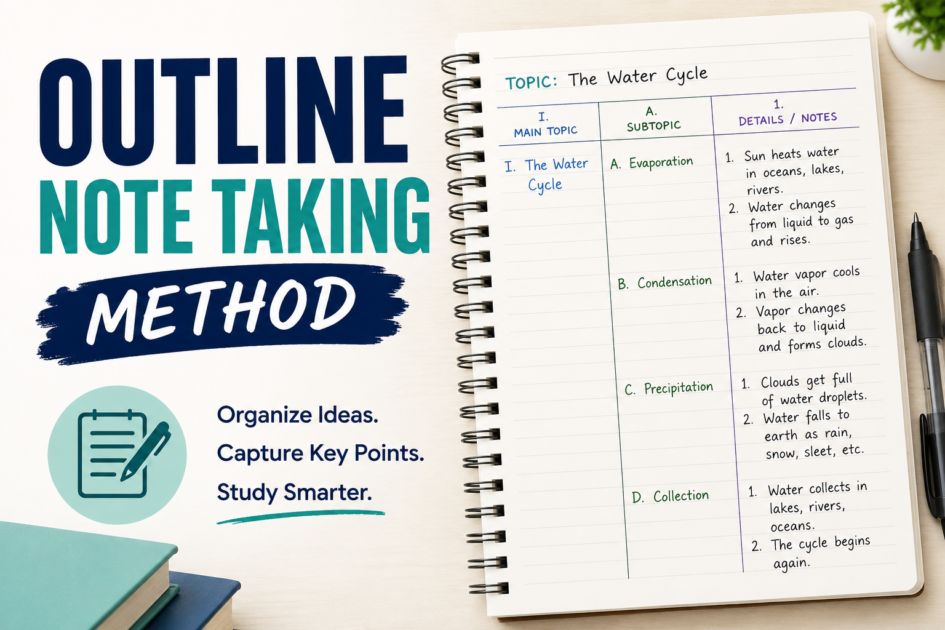
The outline technique captures big ideas first and then branches out into smaller, supporting details underneath.
It looks a lot like a family tree for your thoughts. The main point leads to subpoints, then those subpoints have their own smaller notes.
It’s a flexible technique because it gives you the power to decide how deep to go and how detailed your notes will be.
Who Is It For?
No particular group can gatekeep the outline method. It’s for anyone who wants to make sense of their notes.
Students love it because it makes studying way easier. You can quickly see how everything connects, from the main concept at the top to the supporting points beneath.
Professionals find it useful for presentations and meetings. Discussions are likely to move fast, and the method organizes ideas and decisions as they emerge.
Researchers and writers also swear by it. It’s an incredible method for organizing ideas into sections before converting them into full drafts.
Also Read: Cornell Note-taking Method
How the Outline Method Works
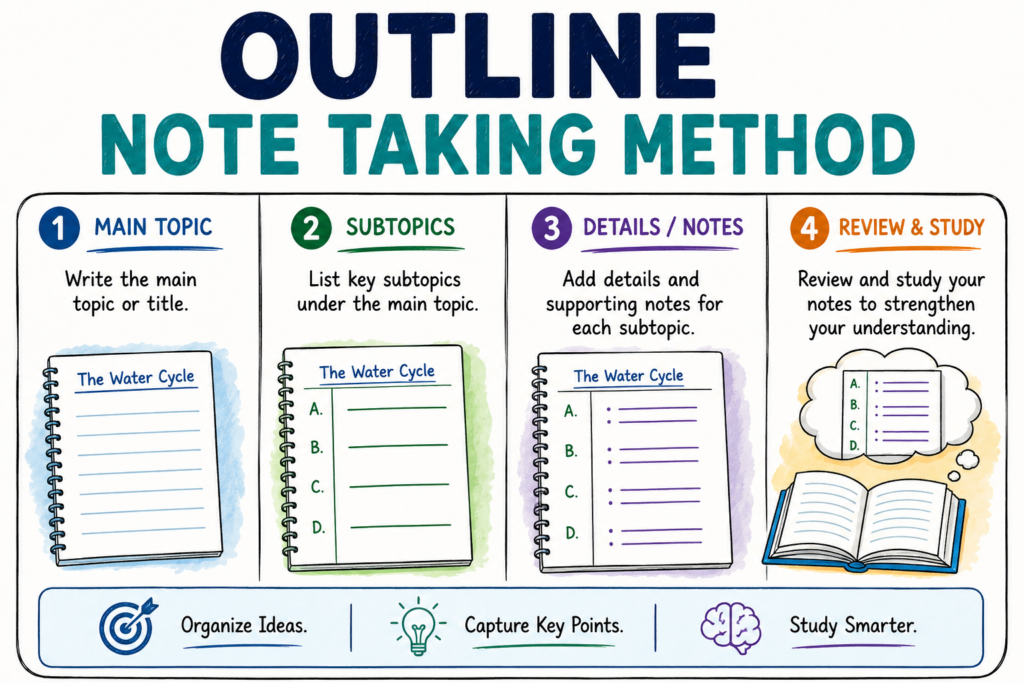
It’s important that you understand how the outline method works and how you can use it.
1. Main Ideas
Every good outline starts with a big picture. The first thing to do when taking notes is to identify the main ideas. They are the central concepts that everything else revolves around. These form the backbone of your notes.
In a meeting, these could be the discussion points or agenda items. And in lectures, they are the key sections of a chapter.
Once you identify the main idea down, everything becomes easier as you go.
2. Subpoints
The next step is to dig a little deeper and add subpoints under each main idea. These are the supporting details that give the main ideas shape and meaning. They could be definitions and summaries; ideally, anything that clarifies the point above it.
In a tree diagram, they would be the branches that grow from the main trunk.
Slightly indent each subpoint and give them their own lines to separate them from the main topic.
3. Supporting Details
Go even deeper with supporting details after writing the main ideas and subpoints. These are the facts and examples that add depth to your notes.
The details enrich your notes and make them more memorable.
4. Visual Cues
Visual cues make your notes easier to read at a glance. They guide your eye and help your brain organize information.
After building your outline, go back and add symbols and formatting. These make it easier to scan your notes.
You can bold or underline key terms and main ideas, while dashes can be used for lists and examples. You can even opt for color-coding for different topics or levels of importance.
5. Review
Taking notes is half the job. The real value comes when you review them. Take a few minutes a day, or once a week, to go through what you’ve written. Simplify the sections that feel cluttered and fill any gaps while the information is still fresh.
Also, remember that your notes are not static. Feel free to reorganize them if it makes more sense.
Why the Outline Method Is So Effective
The outline method encourages you to think critically and structure what you are learning in real time. Here are a few reasons why it works so well.
1. Organizes Notes
Every piece of information has a home with the outline method. The main idea sits at the top, with the subtopics falling neatly below and filling in the gaps.
It creates a hierarchy that makes it easier for the brain to see the big picture and how everything connects. You spend less time hunting through paragraphs and more learning from them.
2. Encourages Active Listening
You are not just copying word-for-word with this method. It’s more about listening for meaning. You are listening actively, identifying key points, and grouping ideas as you go.
This mental sorting keeps your brain engaged and makes it easier to understand material as you write.
3. Simplifies Complex Information
Outlining breaks down intimidating topics into smaller, relatable chunks. Its format allows you to see relationships between ideas and identify patterns that would have otherwise gotten lost in paragraphs.
4. Makes Review Easier
Yes, it may take you a few extra minutes to organize your notes as you write, but it saves you hours later when you are studying and summarizing.
You won’t have to reorganize them then since they are already structured. They are ready to use as they are.
Structure and Understanding
The outlining method brings clarity to your notes. It gives them a clear roadmap and cuts through the clutter. More importantly, it stops you from writing everything down and makes you start focusing on what matters.